The weekend before Thanksgiving is when the deep-cleaning happens. Some of the most common prep habits make a home look and smell clean while loading the air with smoke, fine particles and chemical fumes right before guests arrive. Here is what the research says, and what to do instead.
KEY TAKEAWAYS
- Skip the self-clean cycle this close to Thanksgiving. It heats the oven to roughly 800 to 1,000°F and releases smoke and fumes, including carbon monoxide. Consumer Reports advises running it several weeks before a big gathering.1
- Have the chimney checked before the first fire. Annual inspection is the national standard, and wood smoke's fine particles can trigger asthma attacks.2
- Don't cover cleaning smells with fragrance. About one in three Americans report health problems from fragranced products, and wax melts are not the clean alternative they are marketed as.3
- Never mix cleaners. Bleach plus ammonia makes chloramine gas. Bleach plus acid makes chlorine gas.4
- Keep fryers and generators out of the garage. Carbon monoxide builds up fast, even with the door open.5
- This is the weekend the house gets the full treatment. The guest room gets made up, the bathroom gets scrubbed, the good candles come out, and someone reaches for the oven's self-clean button. With AAA projecting that 81.5 million Americans will travel at least 50 miles from home for Thanksgiving this year,6 a lot of homes are about to fill up with guests, including grandparents, babies, and people living with asthma and allergies.
- The trouble is that several of the most common prep-week habits work against us. They make a home look and smell clean while putting smoke, fine particles and chemical fumes into the air just before everyone arrives. Here are the five we see most, what the research says about each, and what to do instead.
Why the Week Before Thanksgiving Is Hard on Indoor Air
Late November stacks the deck. Windows are shut against the cold, furnaces and fireplaces are firing up, and kitchens are about to work harder than on any other day of the year.In the most recent year with national data, fire departments responded to an estimated 1,139 home cooking fires on Thanksgiving Day, a 321 percent increase over the daily average.7
Indoor air was already working at a disadvantage. EPA's research found levels of about a dozen common organic pollutants running 2 to 5 times higher inside homes than outside, and showed that elevated concentrations can persist in the air long after the activity that caused them is over.8 Whatever goes into the air on Saturday can still be there when the doorbell rings.
Mistake #1: Running the Oven's Self-Clean Cycle This Weekend
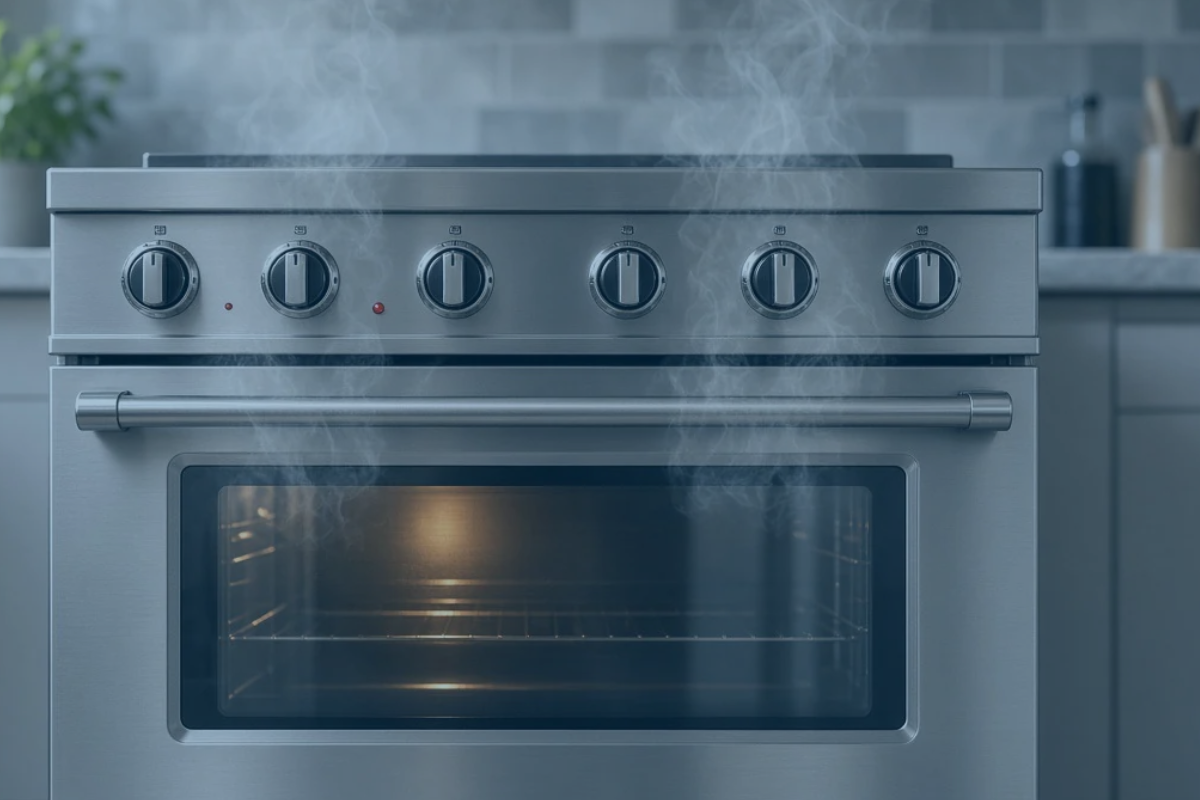
The self-clean cycle is pyrolytic cleaning. The oven locks itself and heats to roughly 800 to 1,000°F, turning baked-on grease into ash. For comparison, broiling runs about 500°F.9 That heat has three consequences worth knowing about.
It puts smoke and fumes into your kitchen. Burning off a year of drips and splatters produces smoke and odors, and the cycle releases carbon monoxide. How much has not been well measured. McGill University's Office for Science and Society could not find a peer-reviewed study quantifying it, and advises opening windows, ventilating well, and leaving the room while the cycle runs.10
It is hard on the oven. Consumer Reports' testing finds the self-clean cycle is generally safe and pretty effective.11 Even so, a repair-parts technical supervisor told Consumer Reports that door latches, heating elements, gas igniters and gaskets can fail during the cycle.12 That is why Consumer Reports' advice is clear: if you are hosting a big gathering like Thanksgiving, run the cycle several weeks in advance.13
It is dangerous for pet birds. The ASPCA Animal Poison Control Center lists self-cleaning ovens among the noxious inhalants for pet birds,14 and avian specialists at UC Davis have identified self-cleaning ovens and overheated nonstick pans as culprits in bird deaths.15
Do this instead
- Clean by hand this close to the holiday. Consumer Reports' best approach is to keep the oven clean as you use it, wiping up spills as they happen and cleaning grease after cooking something fatty.16
- If you do run the cycle, protect the air. Run the range hood, open windows, and keep kids and pets in another room.17 Move birds well away from the kitchen, or out of the house entirely.18
- Save the deep clean for after the holiday, when a repair call will not cost you the turkey.
Mistake #2: Lighting the First Fire in a Chimney Nobody Checked
For plenty of families, a fire on Thanksgiving night is tradition, and for many it is the first fire since last winter. The Chimney Safety Institute of America (CSIA) says the best way to prevent a chimney fire is an annual inspection by a certified chimney sweep,19 following NFPA Standard 211, the national standard for chimneys, fireplaces and vents.20
The air-quality case is just as strong. EPA notes that the biggest health threat from smoke is fine particles, or PM2.5, which can make asthma symptoms worse, trigger asthma attacks, and trigger heart attacks and strokes in people already at risk.21 Wood smoke also carries toxic air pollutants including benzene, formaldehyde, acrolein and polycyclic aromatic hydrocarbons (PAHs).22 A chimney that drafts poorly sends that smoke into the very room where everyone is gathered.
Do this instead
- Book an inspection now if it has been more than a year. Chimney sweep bookings run highest in October and November, as homeowners rush to get ahead of the first fire of the season.23
- Burn only dry, seasoned wood. EPA puts the ideal moisture content at about 20 percent.24
- Respect the vent. CDC's carbon monoxide guidance is simple: do not burn anything in a stove or fireplace that is not vented.25 Open the damper before you light, never leave a fire unattended, and test your carbon monoxide alarms this weekend.
Mistake #3: Covering Up Cleaning Smells With Candles, Plug-Ins and Wax Melts
After a day of scrubbing, it is tempting to finish with a scented candle in every room. But fragrance does not clean the air. It adds to it.
In a nationally representative survey of U.S. adults, researcher Anne Steinemann found that 34.7 percent of Americans report health problems, such as migraine headaches and breathing difficulties, when exposed to fragranced products.26 Air fresheners and deodorizers alone cause health problems for 20.4 percent of Americans.27 Among adults with asthma, 64.3 percent report adverse effects from fragranced products, and 27.9 percent report asthma attacks.28
Flameless does not mean pollution-free, either. A 2025 study in Environmental Science & Technology Letters found that terpenes released by scented wax melts react with ozone in indoor air to form high concentrations of airborne nanoparticles,29 and Purdue University reported that the wax melts polluted indoor air even more than candles.30 Real candles add fire risk at exactly this time of year: NFPA reports that home candle fires peak in December and January.31
Do this instead
- Remove odors instead of masking them. Take out the trash, run the kitchen exhaust fan, and provide plenty of fresh air when using household products, as EPA recommends.32
- Go fragrance-free. Steinemann recommends products that contain no fragrance at all, including the masking fragrance that some "unscented" products contain.33
- Want the glow? Flameless LED candles give you the look with no smoke, no scent chemistry and no open flame.
Mistake #4: Mixing Cleaners to Get the Bathroom Guest-Ready Faster
Combining products feels like it should work twice as fast. In a small, closed bathroom, it can instead create a toxic gas. Mixing bleach and ammonia produces chloramine gas, which can cause chest pain and shortness of breath. Ammonia turns up in places you might not expect, including some glass and window cleaners, dish detergents and drain cleaners, and in urine, which is why bleaching a toilet or a pet accident can cause trouble.34 Mixing bleach with an acid-based cleaner creates chlorine gas.35 CDC's guidance is to never mix household bleach with any other cleaners or disinfectants.36
Even when they are used one at a time, cleansers, disinfectants and air fresheners are among the household products EPA lists as sources of volatile organic compounds (VOCs) indoors.37
Do this instead
- One product at a time, with the fan on. Department of Public Health says never to mix bleach with anything but plain water, and to use cleaning products in a well-ventilated area.38
- Rinse between products, and let the room air out before guests use it.
- If someone feels sick after mixing products, get them to fresh air and call Poison Help at 1-800-222-1222.
Mistake #5: Moving the Turkey Fryer or Generator Into the Garage
Thanksgiving weather is unpredictable. When it turns cold or wet, the garage starts to look like a sensible place for the turkey fryer or a backup generator. It is not.
NFPA discourages the use of turkey fryers that use cooking oil, which can cause devastating burns, and points to infrared fryers, air fryers and electric turkey fryers as safer alternatives.39 The National Park Service's fire prevention guidance is direct: always use the fryer outdoors on a flat surface, away from structures, wooden decks and covered patios, and do not be tempted to use it in a garage. Underwriters Laboratories (UL) does not certify these fryers with its UL label.40
Fuel-burning engines add a quieter danger: carbon monoxide, a gas you cannot see or smell. CDC says never to use a generator inside your home or garage, even if doors and windows are open, and to keep it more than 20 feet from windows, doors and vents.41 The Consumer Product Safety Commission warns that using a generator indoors can kill you in minutes,42 and that deadly levels can linger for hours after the generator shuts off.43 CDC also warns never to run a car or truck in a garage attached to the house, even with the garage door open.44 That is worth remembering when relatives warm up the car for the drive home.
Do this instead
- Fry outdoors only, well away from the house, or skip the oil entirely with an air fryer, infrared or electric turkey fryer.45
- Keep generators outside, more than 20 feet from the house, and use a battery-powered or battery-backup carbon monoxide alarm.46
What an Air Purifier Can, and Can't, Do This Week
Every fix above stops pollution at its source, which EPA calls the most effective solution for most indoor air quality problems in the home. An air purifier picks up from there. It keeps cleaning the air long after the oven is off, the bathroom is scrubbed and the fire has burned down, capturing the fine particles from searing, roasting and wood smoke along with the odors and VOCs that linger behind them.
EPA notes that a portable air cleaner can help improve indoor air quality when smoke is a concern, and explains that filters made with a sorbent such as activated carbon remove gases and odors by adsorbing them. That combination, true HEPA for particles plus a deep bed of carbon for gases and odors, is exactly what a home full of cooking, cleaning and company needs.47
That is the job the Austin Air HealthMate was built for. Its 4-stage system pairs up to 15 pounds of activated carbon and mineral-based zeolite, for gases and odors, with 60 square feet of True Medical Grade HEPA, rated to capture 99 percent of airborne particles down to 0.1 microns.51 Put one where guests gather, in the kitchen or great room, and a HealthMate Junior in the guest room. Filters last up to five years under normal residential use.52
From Our Table to Yours
Thanksgiving is about the people around the table. A few small changes this weekend mean the air they breathe while they are with you is as welcoming as everything else. From all of us in Buffalo, happy Thanksgiving.
Your Pre-Thanksgiving Clean-Air Checklist
This weekend (Nov. 21 to 22)
- Clean the oven by hand. Save the self-clean cycle for after the holiday.
- Book a chimney inspection if it has been more than a year.
- Test every smoke and carbon monoxide alarm.
Monday and Tuesday
- Clean bathrooms one product at a time, with the fan running and the door open.
- Put away plug-ins and wax melts. Swap scented candles for flameless ones.
Wednesday
- Pick an outdoor spot for the fryer, well away from the house, the deck and the garage.
- Start running an air purifier in the guest room before anyone arrives.
Thanksgiving Day
- Run the range hood every time a burner or the oven is on.
- Keep a purifier running where people gather.
- Light the fireplace only with dry wood and an open damper.
Frequently Asked Questions
Is it safe to use the self-clean cycle on my oven?
Consumer Reports' testing finds the cycle is generally safe and effective.54 It does produce smoke and fumes, including carbon monoxide, so ventilate well and leave the room while it runs.55
How far ahead of Thanksgiving should I self-clean my oven?
Consumer Reports recommends running the cycle several weeks before a big gathering like Thanksgiving, so there is time to fix anything that breaks.56 If that window has passed, clean by hand.
Are self-cleaning oven fumes dangerous to pets?
Birds are the biggest concern. The ASPCA Animal Poison Control Center lists self-cleaning ovens among noxious inhalants for pet birds.57 Keep other pets in another room while the cycle runs.58
Do self-cleaning ovens give off carbon monoxide?
Yes. Self-cleaning releases carbon monoxide, though no peer-reviewed study has measured how much, according to McGill University's Office for Science and Society.59
Are candles and air fresheners bad for people with asthma?
They can be. In a national survey, 64.3 percent of U.S. adults with asthma reported adverse health effects from fragranced products, and 27.9 percent reported asthma attacks.60
What happens if you mix bleach and ammonia?
It produces chloramine gas, which can cause chest pain and shortness of breath.61 Get to fresh air and call Poison Help at 1-800-222-1222 if anyone feels unwell.
Can an air purifier remove carbon monoxide?
No. Carbon filters are not expected to remove carbon monoxide.62 Use carbon monoxide alarms, keep fuel-burning equipment vented or outdoors, and get fresh air.
Can an air purifier help with cooking and fireplace smoke?
A portable air cleaner can help improve indoor air quality when smoke is a concern.63 Choose one with true HEPA filtration for fine particles and a substantial carbon bed for odors and gases, and pair it with your range hood and fresh air.
References
¹, ⁹–¹⁰, ¹⁸, ⁵⁵, ⁵⁹. Jarry, J. "Safety and Chemistry of the Self-Cleaning Oven." McGill University Office for Science and Society. June 18, 2018. https://www.mcgill.ca/oss/node/7143
¹, ¹³, ⁵⁶. Consumer Reports. "Is It Safe to Run Your Oven's Self-Clean Cycle?" https://www.consumerreports.org/appliances/wall-ovens/is-it-safe-to-run-your-ovens-self-clean-cycle-a5080836471/
², ²⁰. Chimney Safety Institute of America. "Homeowner Resources" (NFPA 211 inspection guidance). https://csia.org/homeowner-resources
², ²¹. U.S. Environmental Protection Agency, Burn Wise. "Wood Smoke and Your Health." https://www.epa.gov/node/34891
³, ²⁶. Steinemann, A. "Fragranced consumer products: exposures and effects from emissions." Air Quality, Atmosphere & Health 9(8):861–866. 2016. https://pmc.ncbi.nlm.nih.gov/articles/PMC5093181
³, ²⁹. Patra, S.S., Jiang, J., Liu, J., Steiner, G., Jung, N., Boor, B.E. "Flame-Free Candles Are Not Pollution-Free: Scented Wax Melts as a Significant Source of Atmospheric Nanoparticles." Environmental Science & Technology Letters 12(2):175–182. 2025. https://pmc.ncbi.nlm.nih.gov/articles/PMC11823451/
⁴, ³⁴, ³⁸, ⁶¹. Georgia Department of Public Health. "What Not to Mix: Cleaning Products." https://dph.georgia.gov/document/document/envhealthchemhazwhatnottomixeng1020pdf/download
⁴, ³⁵. Blue Cross Blue Shield of Michigan, A Healthier Michigan (citing the National Capital Poison Center). "Never Mix These Cleaning Products." March 17, 2023. https://www.ahealthiermichigan.org/2023/03/17/what-cleaning-products-not-to-mix
⁵, ⁴¹, ⁴⁶. Centers for Disease Control and Prevention. "Carbon Monoxide Poisoning Basics." https://www.cdc.gov/carbon-monoxide/about/index.html
⁵, ⁴⁷, ⁶². U.S. Environmental Protection Agency. "Guide to Air Cleaners in the Home." EPA 402-F-08-004. May 2008. https://19january2021snapshot.epa.gov/sites/static/files/2014-07/documents/aircleaners.pdf
⁶. AAA, via The National Desk. "AAA: 81.5 million Americans expected to travel for Thanksgiving; nearly 90% will drive." November 2026. https://kmph.com/news/nation-world/aaa-815-million-americans-expected-to-travel-for-thanksgiving-nearly-90-will-drive
⁷, ³⁹, ⁴⁵. Carrier Management. "Home cooking fires peak on Thanksgiving Day" (National Fire Protection Association figures). November 16, 2026. https://www.carriermanagement.com/news/2026/11/16/294165.htm
⁸, ³², ³⁷. U.S. Environmental Protection Agency. "Volatile Organic Compounds' Impact on Indoor Air Quality." https://www.epa.gov/indoor-air-quality-iaq/volatile-organic-compounds-impact-indoor-air-quality
¹¹, ¹⁶, ⁵⁴. Consumer Reports, via NewsChannel 5. "Turkey, stuffing and pies: your oven's big day is coming up." November 2025. https://www.newschannel5.com/money/consumer/consumer-reports/turkey-stuffing-and-pies-your-ovens-big-day-is-coming-up
¹², ¹⁷, ⁵⁸. Money Talks News. "Your Oven's Biggest Day Is Nov. 26. Do These 5 Things Now" (summarizing Consumer Reports guidance). November 2026. https://www.moneytalksnews.com/your-ovens-biggest-day-is-nov-do-these-things-now/
¹⁴, ⁵⁷. ASPCA Animal Poison Control Center. "Managing Pet Bird Toxicoses" (Table 1, Examples of Noxious Inhalants). https://aspcapro.org/sites/default/files/apcc_birdtoxic.pdf
¹⁵. MRCVSonline. "UC Davis avian specialists warn of aerosol toxicoses in pet birds." https://mrcvs.co.uk/en/news-story.php?id=12063
¹⁹. Chimney Safety Institute of America. "Chimney Fires: Causes, Effects and Evaluation." https://www.csia.org/chimneyfires.html
²². U.S. Environmental Protection Agency, Burn Wise. "Wood Smoke and Your Health" (archived January 19, 2017). https://19january2017snapshot.epa.gov/burnwise/wood-smoke-and-your-health_.html
²³. Angi. "How Often Do You Need to Clean Your Chimney?" https://angi.com/articles/spring-cleaning-don-t-forget-your-chimney.htm
²⁴. U.S. Environmental Protection Agency, Burn Wise. "Backyard Recreational Fires." https://www.epa.gov/node/164917
²⁵. Centers for Disease Control and Prevention. "Prevention Guidelines: You Can Prevent Carbon Monoxide Exposure." https://stacks.cdc.gov/view/cdc/47927/
²⁷. Steinemann, A. "Frequently Asked Questions." https://www.drsteinemann.com/faqs.html
²⁸, ⁶⁰. Steinemann, A. "Fragranced consumer products: effects on asthmatics." Air Quality, Atmosphere & Health. 2018. https://portfolio.jcu.edu.au/Publications/JCU161722
³⁰. Purdue University College of Engineering. "These Scented Products Pollute Indoor Air Even More Than Candles, Study Shows." March 13, 2025. https://engineering.purdue.edu/Engr/AboutUs/News/Spotlights/2025/2025-0313-are-wax-melts-really-non-toxic-CCEs-Jung-and-Boor-share-air-quality-concerns
³¹. National Fire Protection Association. "December is a leading month for U.S. home fires" (press release). December 4, 2025. https://sierrawave.net/?p=99914
³³. University of Melbourne, via ScienceDaily. "Fragranced products: Risks for people and profits?" October 25, 2016. https://www.sciencedaily.com/releases/2016/10/161024095420.htm
³⁶. KING 5 VERIFY (quoting the Centers for Disease Control and Prevention). "No, it's not safe to mix bleach with other household cleaners." https://king5.com/article/news/verify/mixing-bleach-with-ammonia-acids-other-household-cleaners-is-not-safe-fact-check/536-d88478bc-a3a9-48e1-add9-1486e82ce597
⁴⁰. National Park Service. "Fire Prevention 52: Deep Fried Danger." https://www.nps.gov/articles/p52-deep-fried-turkey-fire-safety.htm
⁴². U.S. Consumer Product Safety Commission. "Carbon Monoxide Information Center: Portable Generator Hazards." https://www.cpsc.gov/node/24288
⁴³. U.S. Consumer Product Safety Commission. "Portable Generator Safety Alert." 2017. https://www.cpsc.gov/s3fs-public/Portable-Generator-Safety-Alert-2017_5123.pdf
⁴⁴. Centers for Disease Control and Prevention. "Carbon Monoxide Poisoning Basics" (vehicles). https://www.cdc.gov/carbon-monoxide/index.html
⁴⁸, ⁶². North Carolina Department of Health and Human Services, Occupational and Environmental Epidemiology. "Air-Cleaning Devices." https://testyourwell.nc.gov/oee/iaq/devices.html
⁴⁹. U.S. Environmental Protection Agency. "An Introduction to Indoor Air Quality: Improving Indoor Air Quality" (archived). https://webarchive.library.unt.edu/eot2008/20080916011342/http:/www.epa.gov/iaq/is-imprv.html
⁵⁰, ⁶³. U.S. Environmental Protection Agency, Burn Wise. "Wood Smoke and Your Health" (archived January 19, 2025). https://19january2025snapshot.epa.gov/burnwise/wood-smoke-and-your-health
⁵¹–⁵². Austin Air Systems. "HealthMate Air Purifier." https://austinairsystems.com/products/healthmate
⁵². Austin Air Systems. "HealthMate Junior Air Purifier." https://austinairsystems.com/products/healthmate-junior