The final part of our Healthy Lung Month series. Follow a single speck of air pollution from the tip of your nose to the deepest part of your lungs, and see why the smallest particles matter most.
KEY TAKEAWAYS
-
You breathe a lot of air. About 17,000 breaths and just over 2,000 gallons of air every day.1
-
Size decides the journey. PM10 particles are 10 microns and smaller; PM2.5 particles are 2.5 microns and smaller, about 30 times thinner than a human hair.2
-
Your nose and throat catch the big ones. Particles under 10 microns can slip past and get deep into your lungs.3
-
The finest particles go the farthest. PM2.5 reaches the air sacs where oxygen enters your blood, and the EPA says some particles may get into your bloodstream.4
-
HEPA is tested at the hardest size to catch. That’s 0.3 microns. Larger and smaller particles are trapped even more efficiently.5
The last stop on our Healthy Lung Month tour
This month we’ve looked at lung cancer in people who never smoked and at what the furnace puts in the air when heating season begins. Both stories kept coming back to the same small villain: fine particles. To finish the series, we’re following one of those particles on its trip through your body.
It’s a trip you take thousands of times a day. Breathing 12 to 15 times a minute adds up to about 17,000 breaths a day, and just over 2,000 gallons of air.6 Most of that air is breathed indoors, where Americans spend about 90% of their time.7
First, how small is a micron?
Airborne particles are measured in microns, also called micrometers. One micron is one-millionth of a meter, or one-thousandth of a millimeter. Too small to picture, so the EPA uses a comparison: a human hair is about 70 microns wide.8
-
PM10: inhalable particles 10 microns and smaller, about one-seventh the width of a hair.9
-
PM2.5: fine inhalable particles 2.5 microns and smaller. The largest of them is about 30 times thinner than a hair.10
-
0.1 micron: the size Austin Air’s HEPA is rated to capture at 99%. That’s about 700 times thinner than a hair.11
Where these particles come from matters too. Fine particles are produced any time fuels such as coal, oil, diesel, or wood are burned. Coarser dust comes from crushing and grinding and from vehicles on paved and unpaved roads.12
The journey, stop by stop
Stop 1: Your nose and throat
Every breath starts here. Your nose and mouth warm and moisten the air before it heads down to your lungs.13 This is also your first filter. Larger particles are filtered out in the nose and throat.14 The EPA notes that larger particles usually don’t reach your lungs, though they can irritate your eyes, nose, and throat.15
But particles smaller than 10 microns can pass through the nose and throat and get deep into the lungs.16 Our speck keeps going.
Stop 2: Your windpipe and bronchial tubes
Next, air travels down the windpipe and into the two bronchial tubes, which branch into thousands of thinner tubes called bronchioles.17 Particles smaller than 10 microns can settle here, in the bronchi.18
Your airways have a built-in cleanup system. The bronchial tubes are lined with tiny hairs called cilia that move a layer of mucus upward, trapping intruders until you cough, sneeze, clear your throat, or swallow.19 Researchers describe this “mucociliary escalator” as both efficient and rapid.20
Stop 3: The air sacs, deep in your lungs
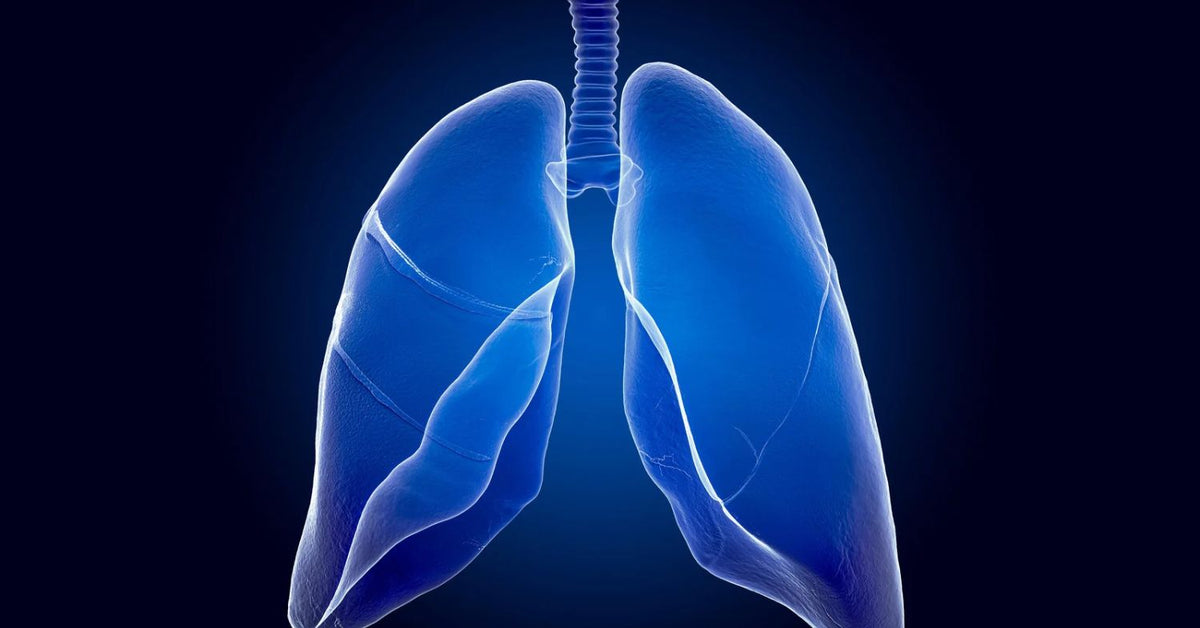
At the very end of the bronchioles are millions of tiny air sacs called alveoli. This is where your body does its most important work: oxygen moves from the air into the blood in the surrounding capillaries, and carbon dioxide moves out.21 All together, the inside surface of your lungs is roughly the size of a tennis court.22
Fine particles, PM2.5, tend to penetrate all the way into this gas-exchange region.23 And here, cleanup is slower. There’s no mucus escalator in the air sacs. Instead, immune cells called alveolar macrophages engulf particles, and that process is slower than clearance in the larger airways.24
Stop 4: Beyond the lungs
For some particles, the journey doesn’t end in the lungs. The EPA says particles less than 10 microns can get deep into your lungs and some may even get into your bloodstream.25 The very smallest, ultrafine particles under 0.1 micron, may pass through the lung’s tissue barriers and affect other organs.26
Why the smallest particles matter most
Of all particle sizes, the EPA says fine particles under 2.5 microns pose the greatest risk to health.27 Exposure to particle pollution has been linked to:28
-
Worsened asthma and reduced lung function
-
More respiratory symptoms, such as airway irritation, coughing, and difficulty breathing
-
Irregular heartbeat and nonfatal heart attacks
-
Premature death in people with heart or lung disease
The EPA says people with heart or lung disease, children, and older adults are among those most likely to be affected.29 Worldwide, the World Health Organization links the combined effects of outdoor and household air pollution to 6.7 million premature deaths a year, and found that 99% of the world’s population lived where its air quality guideline levels were not met in 2019.30
This is the thread that runs through our whole series. In part 1, researchers found more DNA mutations in the lung tumors of never-smokers who breathed more air pollution. In part 2, wood smoke and combustion indoors were mainly fine-particle problems. Small particles travel far.
How a HEPA filter catches what your nose can’t
Your nose is good at stopping big particles and much less effective against fine ones. A HEPA filter is designed for exactly that gap. According to the EPA, a HEPA filter can theoretically remove at least 99.97% of dust, pollen, mold, bacteria, and other airborne particles sized at 0.3 microns.31
Here’s the part most people miss. The 0.3-micron rating isn’t the smallest size a HEPA filter can catch. It’s the hardest. The EPA explains that 0.3 microns “corresponds to the worst case; the most penetrating particle size,” and that “particles that are larger or smaller are trapped with even higher efficiency.”32
That’s why Austin Air rates its True Medical Grade HEPA two ways: 99.97% of airborne particles down to 0.3 microns, and 99% of airborne particles down to 0.1 microns.33 In other words, it reaches into the size range your body’s own defenses handle least well.
Five ways to shorten the journey
The EPA’s advice for cleaner indoor air starts with sources, then ventilation, then filtration.34 Here’s how that looks in practice:
-
Burn less indoors. Fine particles are produced any time fuels such as wood are burned, so fireplaces and wood stoves count.35
-
Vent your cooking. Run a range hood that exhausts outdoors.
-
Check the air before you exercise outside. On high-PM2.5 days, AirNow.gov shows local conditions so you can move workouts indoors.
-
Filter the rooms where you spend the most time. The EPA notes most portable air cleaners and furnace filters can filter particles from the air.36
-
Start with the bedroom. You spend about a third of your life there, breathing the same air all night.
Where Austin Air fits in
Every Austin Air unit is built around the two kinds of protection this series keeps coming back to. The HealthMate combines 60 square feet of True Medical Grade HEPA for fine and ultrafine particles with up to 15 pounds of activated carbon and mineral-based (zeolite) filtration for gases and odors.37 The Bedroom Machine adds a 5th stage of military-grade carbon cloth for the room where you sleep.38
Both are Built in Buffalo with solid steel housings and filters designed to last up to five years in normal residential use. Explore our air purifiers.
Frequently asked questions
What is PM2.5?
PM2.5 is fine inhalable particulate matter 2.5 microns or smaller in diameter. The EPA says the largest of these particles is about 30 times thinner than a human hair, and that fine particles pose the greatest risk to health.39
What is the difference between PM2.5 and PM10?
PM10 includes inhalable particles 10 microns and smaller; PM2.5 is the finer subset, 2.5 microns and smaller. Particles under 10 microns can get past the nose and throat and deep into the lungs, while fine PM2.5 can reach the air sacs where gas exchange happens.40
How big is a micron?
A micron, or micrometer, is one-millionth of a meter. For comparison, the EPA says a human hair is about 70 microns wide.41
Can air pollution particles get into your bloodstream?
Some can. The EPA says particles smaller than 10 microns can get deep into the lungs and some may even get into the bloodstream.42
How do your lungs get rid of particles?
In the airways, tiny hairs called cilia move a layer of mucus upward until you cough or swallow it. In the deep air sacs, immune cells called macrophages engulf particles, a process that is slower than airway clearance.43
Why are HEPA filters rated at 0.3 microns?
Because 0.3 microns is the most penetrating particle size, the hardest size for the filter to catch. The EPA says particles larger or smaller than 0.3 microns are trapped with even higher efficiency.44
Can a HEPA filter catch particles smaller than 0.3 microns?
Yes. Austin Air’s True Medical Grade HEPA is rated to capture 99% of airborne particles down to 0.1 microns.45
The bottom line
Your lungs have remarkable defenses, and they work best on bigger particles. The bigger the particle, the sooner your body stops it. The smaller the particle, the deeper it goes and the longer it stays. That’s why the air inside your home matters so much, and why this Healthy Lung Month, the best gift you can give your lungs is cleaner air to breathe, especially where you sleep.
That’s the Impact of Austin.
References
¹, ⁶, ¹⁹, ²², ⁴³. American Lung Association. (2017, July). How your lungs work. https://www.lung.org/about-us/blog/2017/07/how-your-lungs-work.html
², ⁴, ⁸–¹⁰, ²⁵, ²⁷, ³⁹–⁴². U.S. Environmental Protection Agency. Particulate matter (PM) basics. https://www.epa.gov/pm-pollution/particulate-matter-pm-basics
³, ¹², ¹⁵–¹⁶, ³⁵, ⁴⁰. U.S. Environmental Protection Agency, Office of Air and Radiation. (2003, August). Air quality guide for particle pollution (EPA-452/F-03-002). https://portal.ct.gov/-/media/deep/air/aqi/airqualityguideforparticlespdf.pdf
⁴, ¹⁴, ¹⁸, ²³, ²⁶, ⁴⁰. Sturm, R. (2020). Modelling the deposition of fine particulate matter (PM2.5) in the human respiratory tract. AME Medical Journal, 5. https://amj.amegroups.org/article/view/5437/html
⁵, ³¹–³², ⁴⁴. U.S. Environmental Protection Agency. What is a HEPA filter? https://www.epa.gov/indoor-air-quality-iaq/what-hepa-filter
⁷. U.S. Environmental Protection Agency. Report on the environment: Indoor air quality. https://www.epa.gov/report-environment/indoor-air-quality
¹¹, ³³, ³⁷, ⁴⁵. Austin Air Systems. HealthMate. https://austinairsystems.com/products/healthmate
¹³, ¹⁷, ²¹. National Heart, Lung, and Blood Institute. How the lungs work: The respiratory system. https://www.nhlbi.nih.gov/health/lungs/respiratory-system
²⁰, ²⁴, ⁴³. Ohio, A. J., Stewart, M., Sangani, R. G., Pavlisko, E. N., & Roggli, V. L. (2025). Cigarette smoking decreases macrophage-dependent clearance to impact the biological effects of occupational and environmental particle exposures. Frontiers in Public Health, 13. https://doi.org/10.3389/fpubh.2025.1558723
²⁸–²⁹. U.S. Environmental Protection Agency. Health and environmental effects of particulate matter (PM). https://www.epa.gov/pm-pollution/health-and-environmental-effects-particulate-matter-pm
³⁰. World Health Organization. Ambient (outdoor) air quality and health. https://www.who.int/news-room/fact-sheets/detail/ambient-(outdoor)-air-quality-and-health
³⁴, ³⁶. U.S. Environmental Protection Agency. Guide to air cleaners in the home. https://www.epa.gov/indoor-air-quality-iaq/guide-air-cleaners-home
³⁸. Austin Air Systems. The Bedroom Machine. https://austinairsystems.com/products/the-bedroom-machine
Last updated Nov 6, 2026