Ragweed season is already underway — but the worst of it is still ahead, and this year’s warm fall outlook could stretch it out. Here’s the prep-ahead checklist that actually works, and why the week before Labor Day is the right time to do it.
The 30-Second Version
-
Ragweed peaks in mid-September. The season typically starts in August, peaks mid-September, and runs into October — six to 10 weeks in most places, ending only when the first hard frost arrives.
-
This fall is forecast to be warm. Seasonal outlooks call for above-average temperatures across most of the country through September and October — and a later first freeze means ragweed keeps pollinating longer.
-
It’s a long-term trend, not a one-off. Ragweed season has lengthened at 10 of 11 monitored North American locations since 1995 — by as much as 25 days in the far north — tracking closely with later fall frosts.
-
Prep beats reaction. Allergy medications “work best if started before allergy symptoms develop,” according to the AAAAI. The same logic applies to your house: seal it, filter it, and set your routine now — not in week three of misery.
-
Your home is the one variable you control. You can’t lower the pollen count outside. You can lower the pollen load in your bedroom — and that’s where you spend the most consecutive hours breathing.
Ragweed is already in the air. It has been since early August in most of the country. But if this year follows the pattern, the days that flatten people — the mid-morning sneezing fits, the sinus pressure, the 3 a.m. mouth-breathing — are still two weeks out.
That gap is the whole point of this article.
Ragweed pollen season “peaks in mid-September and can last through October,” according to the Asthma and Allergy Foundation of America, running six to 10 weeks depending on where you live and not truly ending until the first frost. Labor Day weekend lands almost exactly in the runway before that peak. It is the last quiet stretch you get.
And this year, the runway may be longer on the other end than usual.
When is ragweed season — and when does it actually peak?
For most of the United States, ragweed pollen begins in early August, climbs through late August, peaks in mid-September, and tapers through October. The season closes out when temperatures drop below freezing — typically by early November in much of the country, later in the South.
A few things make ragweed uniquely hard to escape:
-
One plant, up to a billion grains. A single ragweed plant can produce up to one billion pollen grains in a season.
-
It travels. Ragweed pollen has been documented as far as 400 miles from where it grew. Pulling up the ragweed in your own yard is a nice gesture. It is not a solution.
-
It’s everywhere. North America is home to roughly 50 species of Ambrosia, with common ragweed the most widespread. It thrives on roadsides, riverbanks, construction edges, farm margins, and vacant lots — disturbed ground it doesn’t need anyone’s permission to occupy.
-
A lot of people react. Ragweed allergy affects more than 23 million Americans, and seasonal allergy overall was diagnosed in 25.7% of U.S. adults in 2021 — better than one in four.
Time of day matters, too. Ragweed is an early riser: peak exposure time for ragweed sufferers is “early midday,” in contrast to grass pollens, which peak in the afternoon and early evening. If you have a choice about when to run, walk the dog, or work in the yard, take the late afternoon.
Why this season could run long
Two things are stacking up.
-
The near-term forecast. Seasonal outlooks for fall 2026 call for above-average temperatures across most of the country in September and October, driven by a strengthening El Niño pattern, with warmth most persistent across the northern tier. Warm falls delay the first freeze — and ragweed doesn’t quit until the freeze arrives.
-
The long-term trend. This isn’t just a 2026 story. EPA’s climate indicator on ragweed tracked 11 locations in the central U.S. and Canada from 1995 to 2015 and found the ragweed pollen season had grown longer at 10 of the 11 — by 25 days in Winnipeg, 21 days in Fargo, and 18 days in Minneapolis. The trends are “strongly related to changes in the length of the frost-free season and the timing of the first fall frost.”
Climate Central’s 2026 analysis found the same mechanism nationwide: the freeze-free season lengthened in 87% of the 198 U.S. cities studied — by an average of 21 days since 1970. And a 2021 study in PNAS found North American pollen seasons have started roughly 20 days earlier and run about eight days longer since 1990, with pollen concentrations up about 21%.
There’s a second lever, too. Ragweed grown under roughly doubled carbon dioxide produced 61% more pollen in Harvard research published in Annals of Allergy, Asthma & Immunology. And ragweed planted along an urban-to-rural gradient near Baltimore flowered earlier and produced more pollen in the city, where CO₂ and temperatures run higher — which researchers described as “a harbinger of what could be expected” more broadly.
Longer season. More pollen per plant. That’s the setup.
It’s not the goldenrod. Really.
Every September, goldenrod takes the blame, because it is the loud yellow thing blooming when everyone starts sneezing. It’s innocent.
Goldenrod is insect-pollinated. Its pollen grains are “too heavy to be transported by wind” — they’re sticky, and they move on the bodies of bees and butterflies, not on the breeze. Ragweed is wind-pollinated, and its flowers are “green and blend into the landscape.” The showy plant isn’t the problem; the invisible one is.
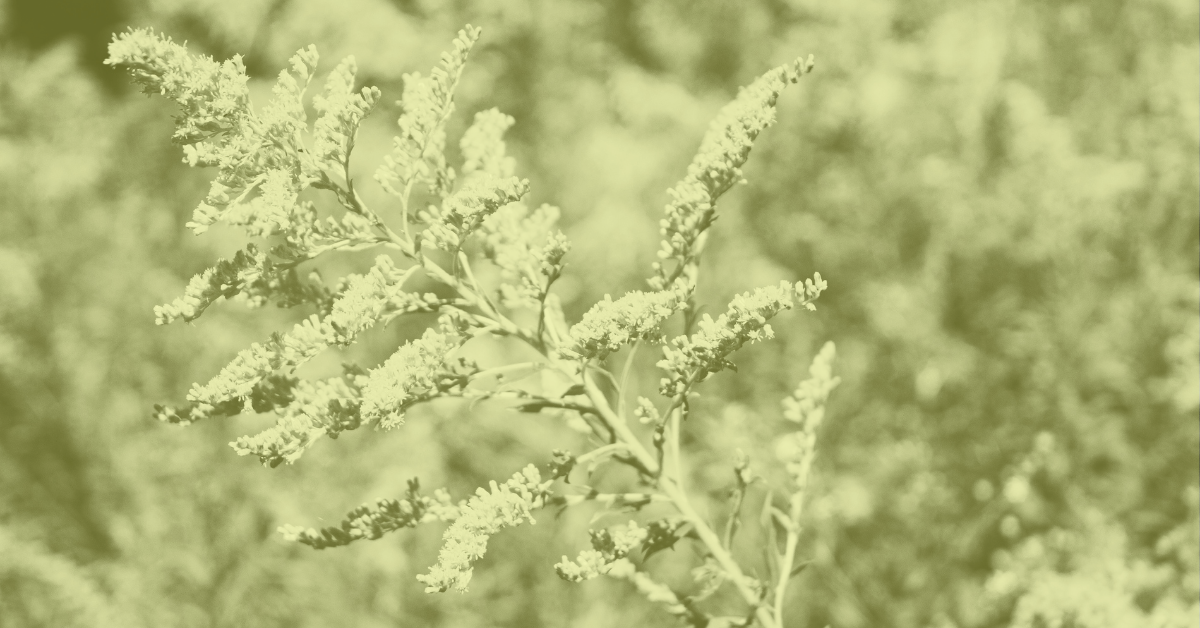
How to tell them apart: goldenrod has bright yellow plumes and broad, simple leaves. Ragweed has small, greenish, unremarkable flower spikes and deeply cut, fern-like leaves. If you’re pulling weeds to reduce pollen, pull the boring one.

What ragweed actually does once it’s inside your house
Here’s the part most fall-allergy checklists skip.
Whole pollen grains are relatively large — large enough that they don’t reach the deepest parts of the lung. But ragweed pollen doesn’t always stay whole. Under humidity and moisture, grains rupture and release sub-pollen particles in the 0.5–4.5 micrometer range — small enough to be inhaled deep into the airways, and still carrying allergenic proteins and oxidase activity. That’s part of why a humid or stormy stretch during ragweed season can feel disproportionately bad, and why symptoms can move from the nose down into the chest.
And pollen gets indoors whether you invite it or not: through open windows and doors, on hair and clothes, on the dog, in the laundry you dried on the line. Since Americans spend about 90% of their time indoors, the amount of ragweed allergen floating around your bedroom is doing more to shape how you feel than the number on the pollen app.
The good news: airborne pollen is exactly the kind of particle mechanical filtration is built to capture.
The pre-Labor Day ragweed checklist
Do these now, while the count is still climbing.
Do this week
-
Talk to your clinician about timing, not just symptoms. The AAAAI is blunt about this: hay fever medications “work best if started before allergy symptoms develop,” because starting early can prevent the release of histamine rather than chasing it. If you take something every fall, the conversation about starting it is a pre-Labor Day conversation, not a late-September one.
-
Close the windows and switch to A/C. The ACAAI recommends keeping “windows closed and using air conditioning in your home or car to reduce your exposure to airborne allergens.” The cool September nights are tempting. They’re also an open door.
-
Move outdoor time to late afternoon. Ragweed exposure peaks in the early midday hours.
-
Shower and change at the door. Shower, wash your hair, and change clothes after extended time outside — otherwise you carry the day’s pollen into your bed.
-
Dry laundry indoors. A clothesline in September is a pollen collector.
-
Wipe the dog down. Pets are efficient pollen delivery vehicles.
-
Check the count, don’t guess. The AAAAI’s National Allergy Bureau reports actual counted pollen levels from certified stations, not estimates.
-
Get the filtration running now. Not when it gets bad. Filtration works by clearing the air repeatedly over time — you want the room already clean when the peak arrives.
What actually filters pollen — and what to look for
The EPA’s guidance is a useful place to start. Portable air cleaners “often achieve a high CADR by using a high-efficiency particulate air (HEPA) filter.” For the gaseous side — odors, VOCs, smoke — the EPA notes that “activated carbon filters can be effective, provided that there is a large amount of material used in the filter.” That qualifier is the whole ballgame: a thin carbon-dusted sheet is not the same thing as pounds of granular carbon.
The EPA also points out that “higher fan speeds and longer run times will increase the amount of air filtered,” and that whole-house HVAC systems typically run less than 25% of the time — a real limitation if the furnace filter is your only plan. And it’s honest about the hierarchy: source control and ventilation with clean outdoor air come first. During ragweed season, though, “ventilate with outdoor air” is exactly the thing you can’t do — which puts more of the load on filtration.
So the checklist for a ragweed-season air cleaner:
-
True HEPA media, with real surface area — not “HEPA-type.”
-
A serious quantity of activated carbon, because fall air isn’t only pollen. It’s also wood smoke, wildfire smoke drift, and the VOCs that build up in a sealed-up house.
-
Sized for the room and run continuously, not switched on when symptoms start.
-
A filter you won’t have to shop for mid-season.
Where the HealthMate fits
This is the machine we’d point a ragweed sufferer to first.
The Austin Air HealthMate uses 4-stage filtration: a large-particle pre-filter, a medium-particle pre-filter, up to 15 lbs of activated carbon and mineral-based (zeolite) filtration, and 60 sq. ft. of true Medical Grade HEPA. Our Medical Grade HEPA is proven to remove 99% of airborne particles down to 0.1 microns*.
Three things make that combination well suited to ragweed season specifically:
The HEPA handles the pollen — whole grains and fragments. Whole ragweed grains are comparatively large and easy to capture. The sub-pollen particles that rupture off them, in the 0.5–4.5 micron range, fall squarely within what medical-grade HEPA is built for.
The carbon and zeolite handle everything else fall brings indoors. Once you close the windows for pollen season, you also stop diluting everything else — cooking fumes, cleaning products, off-gassing, wood smoke, and drifting wildfire smoke. HEPA doesn’t touch gases. The carbon-and-zeolite blend is there for that half of the problem, and there’s enough of it to matter — up to 15 pounds, which is what the EPA’s “large amount of material” language is really describing.
The 5-year filter means you’re not filter-shopping in mid-September. Each HealthMate filter is designed to last five years under normal residential use. A ragweed season that runs long doesn’t cost you a filter change; it just costs you nothing at all. Set it up before Labor Day and it carries you through this season and the next four.
A few placement notes:
-
Bedroom first. It’s where you spend the most continuous hours breathing, and where allergy symptoms do the most damage to sleep. If the bedroom is the priority, the Bedroom Machine adds a fifth stage — military-grade HEGA carbon cloth — and is designed to run at a soft hum that won’t disturb sleep.
-
Kids’ rooms. The HealthMate Junior is the same 4-stage architecture in a smaller footprint, with a 5-year filter.
-
Run it continuously. Longer run time, more air filtered.
Austin Air units have been used in independent clinical research at institutions including Johns Hopkins, Cincinnati Children’s, and the University of Washington — you can read the published trial results here. Every unit is Built in Buffalo, and every filter is a 5-year filter.

If you have kids heading back to class
Ragweed’s peak lands in the third and fourth week of the school year — the same weeks classrooms are refilling and everyone moves back indoors. Congested kids sleep worse, and kids who sleep worse have a harder time in school.
If you want to do something about the air in your child’s classroom, not just their bedroom, our free Parent-Teacher Toolkit has the email templates, fundraising guidance, petition language, and the “See Air Differently” assembly material to make the ask. It costs nothing and it’s built for exactly this conversation.
Ragweed FAQ
When does ragweed season start and end?
Ragweed pollen typically begins in early August, peaks in mid-September, and lasts six to 10 weeks, continuing into October and ending with the first hard frost — often early November in much of the country.
How long does ragweed season last?
Six to 10 weeks in most locations, though it has been getting longer: EPA data show the season lengthened at 10 of 11 monitored North American sites between 1995 and 2015, by up to 25 days.
Is goldenrod the same as ragweed?
No. Goldenrod is insect-pollinated and its pollen is too heavy to travel on the wind; it gets blamed only because it blooms at the same time. Ragweed is wind-pollinated with inconspicuous green flowers.
Where does ragweed grow?
Nearly everywhere in North America — roughly 50 Ambrosia species grow on the continent, favoring disturbed ground like roadsides, fields, riverbanks, and vacant lots. Its pollen has been found 400 miles from the source.
Does an air purifier help with ragweed allergies?
Filtration doesn’t change the pollen count outdoors, but a portable air cleaner with true HEPA media is designed to capture airborne pollen and pollen fragments indoors, where people spend about 90% of their time. Run it continuously and size it to the room.
What foods cross-react with ragweed?
People with ragweed allergy may experience itching or swelling of the mouth with banana, cantaloupe, honeydew, watermelon, cucumber, zucchini, white potato, and sunflower seeds — a pattern known as oral allergy syndrome. Discuss any food reaction with your allergist.
When should I start allergy medication for ragweed?
The AAAAI advises that hay fever medications “work best if started before allergy symptoms develop.” Talk to your clinician about timing before the mid-September peak, not after.
The takeaway
You can’t negotiate with a ragweed plant. It will release its billion grains, the wind will carry them 400 miles, and this year the freeze that ends it may come late.
What you can do is decide what the air inside your house looks like when that happens. Close the windows before you need to. Move the routine — showers, laundry, outdoor time — before the peak, not during it. Have the medication conversation early. And get real filtration running in the room where you sleep, now, so it’s already working when the count spikes.
Prepare-ahead beats catch-up. That’s the whole strategy, and Labor Day weekend is when you have time to execute it.
Trusted for more than 35 years. Built for a Lifetime. Built in Buffalo. That’s the Impact of Austin.
* Proven to remove 99% of airborne particles down to 0.1 microns.
A note on health claims: Austin Air purifiers reduce exposure to airborne particulate matter and many gaseous pollutants indoors. They are not medical devices and do not diagnose, treat, cure, or prevent allergies, asthma, or any other disease. Talk to a qualified healthcare professional about managing allergy symptoms and about any medication timing.
References
¹, ⁵⁻⁶, ⁸, ³⁰, ⁴⁶⁻⁴⁷, ⁵², ⁵⁴ Asthma and Allergy Foundation of America. (n.d.). Ragweed pollen allergy. https://aafa.org/allergies/types-of-allergies/pollen-allergy/ragweed-pollen/
¹, ⁶⁻⁷, ⁹⁻¹¹, ¹⁵, ²⁸⁻²⁹, ⁴⁶, ⁴⁹, ⁵⁴ Allergy & Asthma Network. (n.d.). Ragweed allergies. https://allergyasthmanetwork.org/allergies/pollen-allergy/ragweed-allergy/
², ¹⁴, ⁵⁴ The Weather Company & Atmospheric G². (2026, August 13). Fall outlook: El Niño is taking charge of weather patterns. https://weather.com
³, ¹⁶, ⁴⁷ U.S. Environmental Protection Agency. (n.d.). Climate change indicators: Ragweed pollen season. https://www.epa.gov/climate-indicators/climate-change-indicators-ragweed-pollen-season
⁴, ²⁵, ⁵³, ⁵⁵ American Academy of Allergy, Asthma & Immunology. (n.d.). Hay fever and pollen counts. https://www.aaaai.org
¹² Ng, A. E., & Boersma, P. (2023, January). Diagnosed allergic conditions in adults: United States, 2021 (NCHS Data Brief No. 460). National Center for Health Statistics. https://www.cdc.gov/nchs/products/databriefs/db460.htm
¹³, ²⁶⁻²⁷ American College of Allergy, Asthma & Immunology. (n.d.). Seasonal allergies. https://acaai.org/resource/seasonal-allergies
¹⁷ Climate Central. (2026, March 4). Warmer growing season, longer allergy season. https://www.climatecentral.org/climate-matters/2026-allergy-season
¹⁸ Anderegg, W. R. L., Abatzoglou, J. T., Anderegg, L. D. L., Bielory, L., Kinney, P. L., & Ziska, L. (2021). Anthropogenic climate change is worsening North American pollen seasons. Proceedings of the National Academy of Sciences, 118(7), e2013284118. https://doi.org/10.1073/pnas.2013284118
¹⁹ Wayne, P., Foster, S., Connolly, J., Bazzaz, F., & Epstein, P. (2002). Production of allergenic pollen by ragweed (Ambrosia artemisiifolia L.) is increased in CO₂-enriched atmospheres. Annals of Allergy, Asthma & Immunology, 88(3), 279–282. https://pubmed.ncbi.nlm.nih.gov/11926621/
²⁰ Ziska, L. H., Gebhard, D. E., Frenz, D. A., Faulkner, S., Singer, B. D., & Straka, J. G. (2003). Cities as harbingers of climate change: Common ragweed, urbanization, and public health. Journal of Allergy and Clinical Immunology, 111(2), 290–295. https://pubmed.ncbi.nlm.nih.gov/12589347/
²¹⁻²², ⁴⁸ University of Illinois Extension. (2022, October 21). Autumn allergies: Don’t blame goldenrod. Good Growing. https://extension.illinois.edu
²³, ³⁸ Environmental Health Perspectives. (n.d.). Headliners—Allergies: Ragweed subpollen particles reach deep into lungs. National Institute of Environmental Health Sciences. https://www.ncbi.nlm.nih.gov/pmc/articles/PMC1852696/
²⁴, ⁵⁰ U.S. Environmental Protection Agency. (n.d.). Indoor air quality. Report on the Environment. https://www.epa.gov/report-environment/indoor-air-quality
³¹ American Academy of Allergy, Asthma & Immunology. (n.d.). National Allergy Bureau pollen and mold station data. https://www.aaaai.org/global/nab-pollen-counts
³²⁻³⁵, ³⁹, ⁴³, ⁵⁰⁻⁵¹ U.S. Environmental Protection Agency. (n.d.). Guide to air cleaners in the home. https://www.epa.gov/indoor-air-quality-iaq/guide-air-cleaners-home
³⁶⁻³⁷, ³⁹⁻⁴⁰ Austin Air Systems. (n.d.). HealthMate. https://austinairsystems.com/products/healthmate
⁴¹ Austin Air Systems. (n.d.). Bedroom Machine. https://austinairsystems.com/products/the-bedroom-machine
⁴² Austin Air Systems. (n.d.). HealthMate Junior. https://austinairsystems.com/products/healthmate-junior
⁴⁴ Austin Air Systems. (n.d.). Clinical trials. https://austinairsystems.com/pages/clinical-trials
⁴⁵ Austin Air. (n.d.). Parent-teacher toolkit. https://info.austinair.com/parent-teacher-toolkit-home
Last updated Sept 10, 2026.