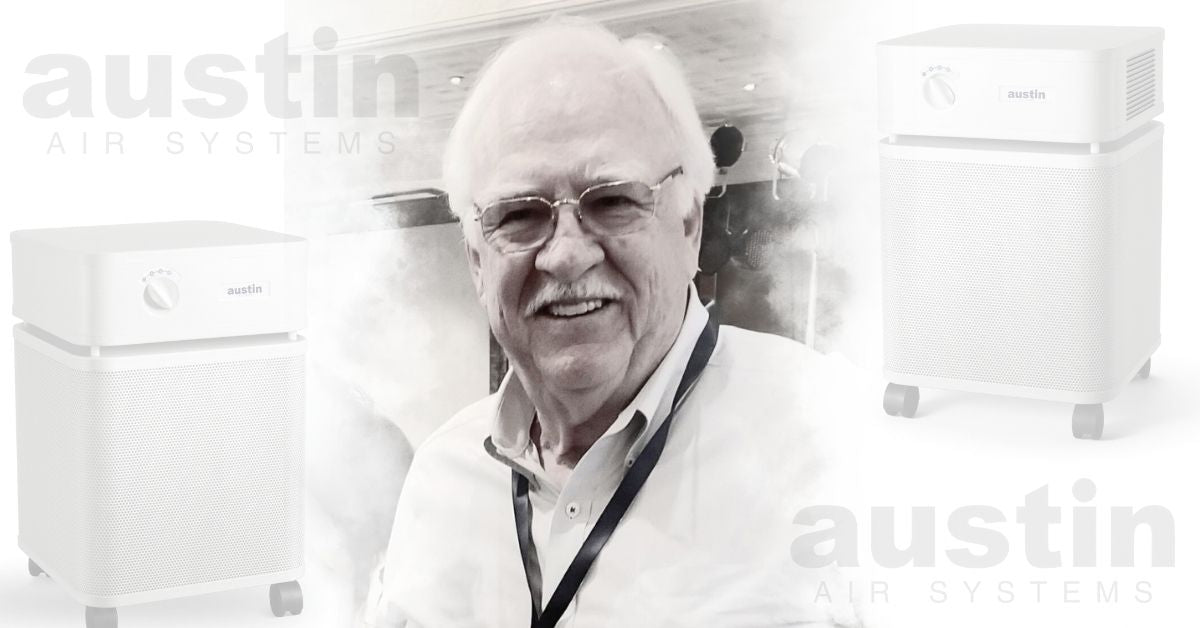
For 35 years, Austin Air has done something exceptional in modern manufacturing: build a product so dependable and so clinically validated that it has become synonymous with serious air purification.
As Austin Air celebrates its 35th anniversary, we’re looking back at the early years that shaped the company. What started as a personal search for respiratory relief has grown into one of the world’s most trusted clean-air technologies—used in homes, classrooms, research labs, government programs, and medical environments.
The polished product people know today began with something far humbler with a small workshop, a handful of machines, and one man who was compelled to build something the world didn’t yet realize it needed. The story is less about nostalgia and more about endurance: a commitment to building lasting machines that genuinely help people breathe better and live healthier lives.
A Beginning Rooted in Need, Not Marketing
It’s an unfortunate fact: the air inside is (typically) more polluted than the air outside. Thankfully, before air quality was trending, before wildfire season lasted year-round, before the globe-stopping COVID pandemic—one man saw the problem clearly: not as a business plan but as a personal mission.
Richard Taylor was deeply concerned about the ongoing health problems of a close loved one. They suffered from severe respiratory issues and chemical sensitivities that conventional solutions like rescue inhalers and medication couldn’t relieve. The breathing problems were extreme and persistent. Refusing to accept that something as imperative as breathing should be a struggle, Richard set out to create an environment where his loved one felt relief—bringing home the filtered air of a hospital cleanroom.
A cleanroom is a specially designed, highly controlled environment where the concentration of airborne particles, microbes, and other contaminants is kept within strict protocols to reduce infection risks.1 Cleanrooms came into being during the mid-twentieth century but were still somewhat novel in the 1980s, when Richard Taylor was inspired to recreate their conditions.2
The Mission Begins
There are two major parts of having a vision to create something; be it a work of art, a recipe, or an invention: concept and execution. Realizing that hospital cleanrooms were the best place for people with severe respiratory ailments and setting out to replicate those outcomes was the first step, but actually translating inspiration into a tangible solution required know-how and boldness—Richard Taylor had plenty of both.
Instead of creating specialized clean spaces, he set out to design a medical-grade air purifier from scratch. This is where another special element that led the way for Austin Air Purifiers to be created came in handy: earlier in his career, Richard worked in the small appliance industry.
Inspired by cleanrooms, he went straight to hospital specialists to learn the most valuable element for air purification. The answer, then and now, was high efficiency particulate air (HEPA) paper. HEPA has an incredible ability to purify air because its matrix of densely organized fibers captures extremely small contaminants with proven consistency.
Once he was armed with HEPA to filter physical particulates, Richard looked for a method to remove the gases, volatile organic compounds (VOCs), and other pollutants that can pass through HEPA. His ultimate goal was complete filtration. He turned to an unlikely place for advice: the Department of Defense. Specifically, he consulted experts about the materials used in gas masks to protect soldiers. and that is how solid activated carbon joined the formula.
Combining medical-grade HEPA filtration and activated carbon—technologies used in medical, military, and industrial settings—he designed an air purifier that could remove both particulates and gaseous chemical contaminants; an innovation that is as close as possible to complete filtration, which has remained the foundation of Austin Air’s product line.
He started by tinkering in his garage and created the first model of personal air purifier in the late 1980’s. In addition to HEPA and activated carbon, Richard had the good sense to use steel instead of plastic, which can off-gas harmful contaminants. He also chose powder coat paint because it doesn’t have solvents with lingering fumes that irritate lungs like typical paints.
Within a week of using it, his loved one began sleeping through the night and breathing easier.

From a Workshop to the World
After a few years of experimenting and perfecting the design, Richard released our inaugural model: the Austin Air HealthMate in late 1990. It became the first-ever medical-grade air purifier available to American consumers. Within a few years, the purifier gained the attention of respected medical and healthcare professionals for its HEPA media’s ability to remove up to 99.97% of particles larger than 0.3 microns and 99% of particles larger than 0.1 microns, as well as a wide range of gaseous materials.
Now that the HealthMate was in production to be sold, Richard’s earlier relationships in the small appliance industry became lifelines—connecting him with people who could stamp the steel housings, supply activated carbon, source motors, and help shape the first-generation filters.
This network assisted Richard in building the air purifier he envisioned but innovation and connections aren’t enough to guarantee success. Especially because Austin Air was years ahead of public demand and environmental awareness.
A Small Operation With a Van Packed to the Brim
At the time of launching in 1990, the work was split between Buffalo and Ontario (Canada) where Richard was from. The raw materials would arrive, cut-to-size, from Canada before being formed or welded in Buffalo. After being hand-assembled, everything was loaded tightly and strategically into Richard’s large van. As lead machinist Paul Bona remembers, “We knew exactly how to pack everything to maximize the amount we could fit. Every inch counted.”
Richard would personally drive the van across the Canadian border, where powder coat painting was completed. A day or two later, he’d bring the finished pieces back to Buffalo where his small team of just 2-3 people completed final assembly, testing, and packaging of the units by hand.
Paul recalls that Richard taught every step of the process himself: “Every job we did—Richard was the one who would say, ‘This is how this is going to be done. This is how I want this done.’ Everything we do, he showed everybody how to do, starting with me.”
During this period, the company also pioneered advanced filtration technologies: introducing HEGA carbon cloth for the capture of ultra-fine gas molecules. Austin Air also built purifiers for chemically-sensitive consumers and even created a custom unit to help Kuwait combat air pollution from the oil-fire aftermath of Desert Storm.

Scaling Up
Austin Air grew steadily during the first decade—adding presses, tools, and equipment as demand increased and gradually brought more production steps in-house, eventually becoming a fully self-contained manufacturing operation by 1998 in our 480,000-square-foot manufacturing facility.
Austin Air’s most dramatic period of growth came decades later, during the COVID-19 pandemic, when global demand for high-capacity air filtration surged almost overnight. To meet that need, Austin Air had to scale at remarkable speed. By the end of 2021, Austin Air had increased its machinery nearly ten-fold from where it began in 1990. The ability to respond at scale was the direct result of decades of foresight built into both the product and the manufacturing process.
From the earliest stages of product and production design, Richard believed the air purifier industry would one day experience a sudden and significant increase in demand. With that conviction, he made foundational decisions that prioritized flexibility and scalability while maintaining quality.
One of the most consequential choices was to manufacture Austin Air purifiers from steel rather than injection-molded plastic. Beyond steel’s other benefits—including strength and the fact that it does not off-gas—this approach avoided the lengthy tooling lead times and fixed cycle constraints associated with injection molding. Steel fabrication made it possible to rapidly expand output, rather than redesigning parts or waiting months for new molds.
Another ingenious decision was deliberately designing a production line capable of quick expansion, allowing new machinery to be integrated quickly and efficiently as demand increased.
No one could have anticipated the COVID-19 pandemic or the way it would change the world. However, Richard had long believed that a major increase in demand for air purification would one day occur—and the carefully designed production process allowed Austin Air to rise to that moment, scaling quickly to meet the unprecedented demand that followed.
Tested and Trusted In Crises
As Austin Air broadened, so did the scientific interest in whether medical-grade filtration could meaningfully improve human health. Many air purifiers on the market make promises; few are tested rigorously. Austin Air became the exception.
At the turn of the millennium, Battelle Laboratories—one of the most respected governmental testing labs—tested more than 100 air purifiers. The Austin Air HealthMate was selected as the top performer for chemical and VOC filtration. That was a major breakthrough. No longer just a home product, Austin Air became a trusted resource in times of crisis. This proved to be a major turning point for Austin Air.
Shortly after, the terrorist attacks of September 11, 2001 took place and products from Austin Air were recommended by the American Red Cross, FEMA, and the U.S. Department of Housing and Urban Development to help mitigate the harmful effects of soot, ash, chemicals and VOCs released into the air. For one example, tens of thousands of New Yorkers were given vouchers to purchase Austin Air Purifiers outright by a range of aid organizations following the tragic events.
Next, in 2002, during the destruction of chemical weapons stockpiles in Anniston, Alabama, the U.S. government issued over 28,000 Austin Air purifiers to families in the surrounding county as a protective measure. It was—at that time—the largest deployment of residential air purifiers ever.3
A California Catastrophe and the Conclusion that Followed
When the massive SoCal Gas Leak hit Aliso Canyon in 2015 community leaders and public-health officials needed an immediate, proven solution to protect residents from one of the largest natural gas disasters in U.S. history. SoCal Gas, the utility company responsible for the leak, turned to Austin to provide thousands of air purifiers to homes and schools in the area.
A remarkable and unexpected discovery followed a few years after the Aliso Canyon deployment. Education researchers from the Annenberg Institute at Brown University compared student achievement in schools that received classroom air filters with those that did not. They found that exposure to filtered air led to significant improvements in academic performance in math and English, as well as attendance, with gains that persisted into the following year.4
These are the kinds of improvements typically associated with major (and expensive) educational reforms, showing that something as fundamental as cleaner air can have an outsized impact. Because air quality readings during the testing period no longer showed detectable natural gas pollutants in classrooms, the researchers concluded that the cognitive and academic benefits likely came from removing common airborne pollutants.
This work adds to a powerful body of evidence that ensuring clean indoor air is important for cognitive function and IQ, helping students achieve at higher levels and attend more consistently.56789

Proof in Science: Clinical Trials & Real Results
To excel in laboratory testing is one thing, shining through clinical trials is another. Since 2001, Austin Air has partnered with leading medical and research institutions to run some of the nation’s most detailed, controlled trials on indoor air quality and health outcomes.
Our clinical research journey began when the American Academy of Pediatrics and Cincinnati Children’s Hospital selected the HealthMate line for a study on children with asthma, just 11 years after the unit was launched. Over twelve months, children saw fewer asthma attacks and significantly fewer emergency room visits, even those who lived with chronic secondhand smoke exposure.10
Further collaboration followed in 2009 when Johns Hopkins University embarked on a trial measuring how effectively Austin Air purifiers could reduce nitrogen dioxide (NO₂) in homes with gas stoves. NO₂ is a respiratory irritant known to worsen asthma and COPD symptoms. The results were striking: with two Austin units running, indoor NO₂ levels dropped substantially, improving day-to-day air quality for participants.11
Johns Hopkins later ran a study focused on second-hand smoke exposure for pregnant women and families with very young children. With two Austin Air Purifiers installed in each home, researchers documented significant reductions in PM2.5—among the most dangerous categories of airborne particles.12
Researchers at Johns Hopkins once again selected Austin Air purifiers for a clinical trial in 2021, checking symptoms for people living with COPD. Indoor air quality improved within the first week and stayed consistently lower throughout the trial. Within six months, participants using Austin Air units experienced measurable improvements in symptoms and decreased medication usage.13
Clinically Shown to Remove Indoor Pollutants Coming from Outdoors
Austin Air purifiers were also put to the test in other common conditions. In 2015, the University of Washington studied children with asthma living in Washington’s Yakima Valley, a region affected by significant agricultural pollution. Austin Air Purifiers placed in bedrooms and living areas reduced indoor pollution levels by 48% in shared spaces and 65% in bedrooms, reducing asthma triggers in children.14
In 2019, researchers from Franklin W. Olin College of Engineering led a study in East Boston to investigate how Austin Air filtration might protect people living near major traffic corridors and airport pollution. Participants with Austin Air Purifiers saw a dramatic tenfold decrease in indoor pollution. Researchers also recorded measurable improvements in blood pressure.15
Across these six published clinical trials, the pattern has been consistent: cleaner air, fewer symptoms, and meaningful improvements in human health. These results have positioned Austin Air as the only air purifier brand to be independently tested and clinically proven across multiple conditions—not once, but repeatedly, and by some of the country’s most respected medical institutions.
The science continues to validate what Richard Taylor had believed since the beginning: when you build a purifier that genuinely removes contaminants at medical-grade levels, the health effects follow.

A 35-Year Legacy Built to Last
From the very beginning, Austin Air has stood apart in its commitment to craftsmanship. Every purifier is hand-built in Buffalo, New York—from metal forming to filter assembly to final quality checks—ensuring complete control over quality and performance. That hands-on approach has never changed, from an uncertain start during those early days through the growth into a global leader in air purification.
Perhaps the most remarkable part of Austin Air’s 35-year story is how little its core design philosophy has shifted despite decades of success. While competitors release new models to chase trends, Austin Air machines remain grounded in stable, proven engineering. They are not redesigned for aesthetics or marketing cycles; they are built for one job, and they do that job exceptionally well. In fact, the company still produces replacement filters compatible with the very first units made in 1990—an almost unheard-of commitment with planned obsolescence as the default for most businesses.
What began as Richard Taylor’s personal mission to help a loved one breathe easier has grown into a global effort to improve indoor air quality through clinical-grade filtration, honest engineering, and durability that lasts decades. Over the years, Austin Air purifiers have been tested not only in laboratories, but in real-world crises—deployed during wildfire smoke emergencies, industrial accidents, urban pollution events, and chemical exposure incidents. The reputation that followed was built on outcomes, not advertising: when an Austin Air purifier enters a room, people breathe better. Physicians have observed it. Researchers have documented it. Families, schools, and communities have experienced it.
Today, Austin Air products are used in more than 100 countries and trusted by healthcare professionals, first responders, educators, and households alike. Units built in the 1990s are still running—a quiet but powerful affirmation that craftsmanship, consistency, and integrity still matter.
As Austin Air marks its 35th year from 2025 through 2026, the challenges that first made the company necessary—pollution, chemical exposure, and respiratory illness—have only become more urgent. Yet the company enters its next chapter with the same clarity of purpose that shaped its beginning. Technologies may evolve and needs may shift, but Austin Air’s values—and the quality of its products—remain unchanged. This history matters because it shows what’s possible when a brand is built on integrity instead of trends. If the first 35 years have proven anything, it’s that this legacy is just getting started.

REFERENCES
1 Naughton P. (November 2019). History of cleanrooms. American Society of Heating, Refrigerating and Air-Conditioning Engineers Journal. https://www.ashrae.org/file%20library/technical%20resources/ashrae%20journal/125thanniversaryarticles/38-54_naughton_historical_v2.pdf
2 Dancer, SJ. (2023). Hospital cleaning: past, present, and future. Antimicrobial Resistance and Infection Control, 12(1), 80. doi: 10.1186/s13756-023-01275-3 https://pmc.ncbi.nlm.nih.gov/articles/PMC10464435/
3 Ryan D. (2020 November 16). Austin Air Systems is Beating Gigantic Multinational Competitors in the Air Purifier Marketplace. Buffalo Rising. https://www.buffalorising.com/2020/11/austin-air-systems-is-beating-gigantic-multinational-competitors-in-the-air-purifier-marketplace/
4 Gilraine, M. (March 2020). Air Filters, Pollution and Student Achievement. EdWorkingPaper: 20-188. Retrieved from Annenberg Institute at Brown University: http://www.edworkingpapers.com/ai20-188.
5 Calderón-Garcidueñas L, Mora-Tiscareño A, Ontiveros E, et al. (2008 June 11). Air pollution, cognitive deficits and brain abnormalities: a pilot study with children and dogs. Brain Cogn. 68(2): 117-27. doi: 10.1016/j.bandc.2008.04.008.
6 Block ML, Calderón-Garcidueñas L. (2009 August 26). Air pollution: mechanisms of neuroinflammation and CNS disease. Trends Neurosci. 32(9): 506-16. doi: 10.1016/j.tins.2009.05.009.
7 Sunyer J, Esnaola M, Alvarez-Pedrerol M, et al. (2015 March 3). Association between traffic-related air pollution in schools and cognitive development in primary school children: a prospective cohort study. PLoS Med. 12(3): e1001792. doi: 10.1371/journal.pmed.1001792.
8 Landrigan PJ, Fisher S, Kenny ME, et al. (2022 July 18). A replicable strategy for mapping air pollution’s community-level health impacts and catalyzing prevention. Environ Health. 21, 70. doi: 10.1186/s12940-022-00879-3.
9 Air purification reduces children’s morbidity in the daycare. (2024 September 11). E3 Pandemic Response and Enterprise Solutions. https://www.pandemicresponse.fi/post/air-purification-reduces-childrens-morbidity-in-the-daycare.
10 Lanphear BP, Hornung RW, Khoury J, et al. (2011 January 1) Effects of HEPA air cleaners on unscheduled asthma visits and asthma symptoms for children exposed to secondhand tobacco smoke. Pediatrics. 127(1):93-101. doi: 10.1542/peds.2009-2312.
11 Paulin LM, Diette GB, Scott M, et al. (2014 January 11). Home interventions are effective at decreasing indoor nitrogen dioxide concentrations. Indoor Air. 24(4): 416-24. doi: 10.1111/ina.12085.
12 Rice JL, Brigham E, Dineen R,et al. (2017 October 29.)The feasibility of an air purifier and secondhand smoke education intervention in homes of inner city pregnant women and infants living with a smoker. Environ Res.160: 524-530. doi: 10.1016/j.envres.2017.10.020.
13 Hansel NN, Putcha N, Woo H, et al. (2022 February 15.) Randomized Clinical Trial of Air Cleaners to Improve Indoor Air Quality and Chronic Obstructive Pulmonary Disease Health: Results of the CLEAN AIR Study. Am J Respir Crit Care Med.205(4): 421-430. doi: 10.1164/rccm.202103-0604OC.
14 Riederer AM, Krenz JE, Tchong-French MI, et al. (2020 September 29.) Effectiveness of portable HEPA air cleaners on reducing indoor PM2.5 and NH3 in an agricultural cohort of children with asthma: A randomized intervention trial. Indoor Air. 31: 454– 466. doi: 10.1111/ina.12753.
15 Hudda N, Eliasziw M, Hersey SO, et al. (2021 January 25). Effect of Reducing Ambient Traffic-Related Air Pollution on Blood Pressure. Hypertension. 77: 823–832. doi: 10.1161/HYPERTENSIONAHA.120.15580.