For thousands of people, September 11th did not end on September 11th. A quarter century later, it is still ending. This is a remembrance — and an honest accounting of the air.
KEY TAKEAWAYS
-
The dust is still taking lives. A new FDNY report released September 1, 2026 found that more than 600 FDNY members have died of 9/11-related illness in the 25 years since — well beyond the 343 lost on the day itself.
-
The exposure was enormous. An estimated 400,000 people were exposed to the dust, smoke and fumes in Lower Manhattan and nearby Brooklyn.
-
It was not ordinary dust. It was pulverized concrete, gypsum, glass fiber, asbestos, metals and combustion byproducts — alkaline enough to reach a pH near 10, and caustic to the airways that breathed it.
-
The public was reassured too early. EPA’s own Inspector General later found the agency "did not have sufficient data and analyses" to declare the air safe on September 18, 2001.
-
Austin Air answered the call. Following the attacks, our air purifiers were recommended by the American Red Cross, FEMA and the U.S. Department of Housing and Urban Development, and we filled what remains the largest deployment of air cleaners in our company’s history.
-
Twenty-five years later, the machines are still built in Buffalo. Same city, same hands, 35 years after the company started.
"Never Forget" Has a Second Meaning Now
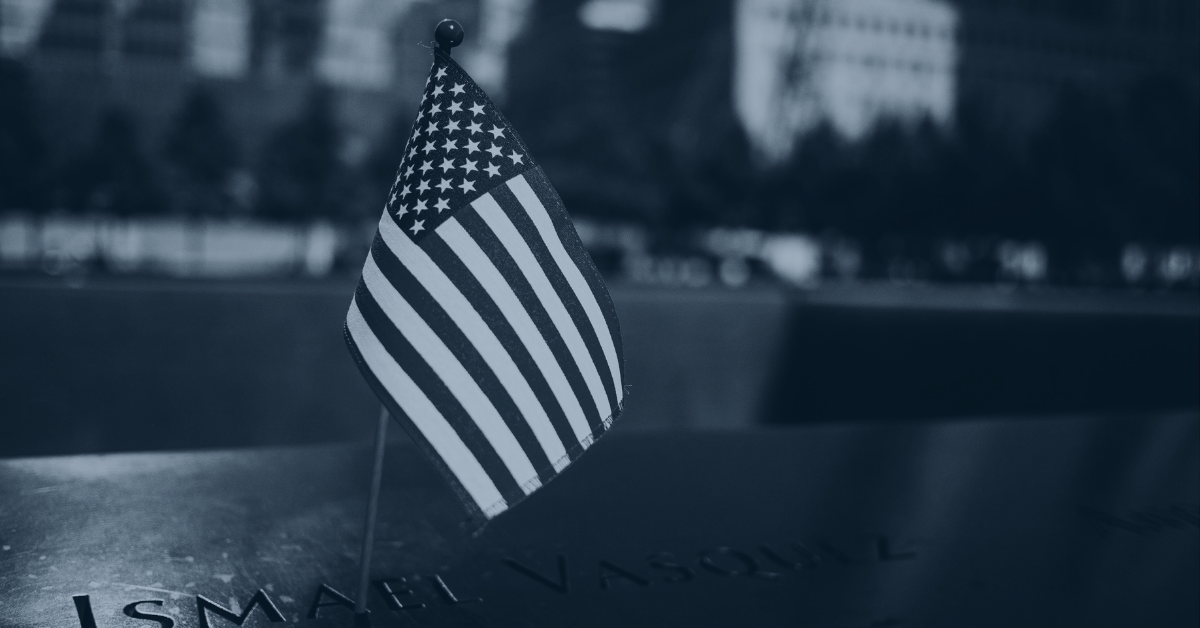
At the National September 11 Memorial, 2,983 names are cut into the bronze parapets that edge the two pools — the people killed in the 2001 attacks and in the 1993 bombing of the World Trade Center. Those names will not change.
There is another list, and it is not finished.
On September 1, 2026, the City of New York and the FDNY released a World Trade Center 25-Year Health Impact Report. It found that more than 600 FDNY members have died of 9/11-related illness — nearly double the 343 firefighters killed on the morning of the attacks. More than 10,000 FDNY members are living today with at least one certified 9/11-related condition, and roughly 4,250 have been diagnosed with cancer, about a quarter of them with more than one.
"Sadly, we know that 9/11 was not a one-day event for our department. It is a day that continues to sicken our members." — FDNY Commissioner Lillian Bonsignore
The firefighters are the part of the story most people know. They are not the whole of it. As of March 31, 2026, the federal World Trade Center Health Program had 143,340 members enrolled — 70,850 responders, 55,326 survivors, and 1,470 responders from the Pentagon and Shanksville. Roughly 96,200 of them, about two-thirds, have been certified with at least one WTC-related health condition.
"Survivors," in the language of the program, means the people who simply lived there. Residents. Office workers. Schoolchildren. Shopkeepers who swept the same dust off the same sidewalk every morning for months. They were not at Ground Zero. Ground Zero came to them, through their windows.
What Was Actually in the Air
When 110 stories come down in ten seconds, the building does not fall. It is ground into powder, and the powder goes up.
Researchers who analyzed the settled dust found that roughly 80 to 90 percent of it was crushed concrete, gypsum from wallboard, and synthetic vitreous fibers — the glass and slag wool used for insulation. Mixed through it were asbestos, lead, chromium, nickel and persistent organic pollutants. Because the crushed concrete released calcium hydroxide and the wallboard released calcium sulfate, the dust was highly alkaline, with measured pH values reaching about 10. It did not simply irritate the airway. It burned it.
The CDC’s own account of the exposures adds the rest of the inventory: cement, cellulose, glass fibers, soot, paint, jet fuel residue and plastics, plus metals, polycyclic aromatic hydrocarbons, PCBs, dioxins and pesticides. And the fires did not go out. The six-story pile of smoking rubble at Ground Zero burned, on and off, through the end of December 2001, with flare-ups into 2002.
That is the detail people forget when they picture the famous white cloud rolling up the avenues. The cloud was one day. The smoke was three and a half months — a slow, continuous release of combustion particles into the lungs of a city that had gone back to work.
Most of the settled dust was coarse, in the 2.5 to 100 micron range, which is why it coated everything so visibly. But coarse dust does not stay put. Swept, walked on, driven over and stirred by every opening door, it re-suspended into the air again and again — which is why the exposure lasted far longer than the collapse did, and why so much of it happened indoors.
"The Air Is Safe to Breathe"
On September 18, 2001, one week after the towers fell, the U.S. Environmental Protection Agency told New Yorkers their air was safe.
Two years later, EPA’s own Office of Inspector General published its review of the agency’s response. Its finding was blunt: when EPA made that announcement, "it did not have sufficient data and analyses to make such a blanket statement." Monitoring data was still missing for pollutants including PCBs and particulate matter, and more than a quarter of the dust samples analyzed before September 18 had shown asbestos above EPA’s own one-percent benchmark.
The same report documented that the White House Council on Environmental Quality "influenced, through the collaboration process, the information that EPA communicated to the public through its early press releases when it convinced EPA to add reassuring statements and delete cautionary ones." Guidance recommending professional cleaning of buildings was among what came out.
We are not raising this to relitigate 2001. We are raising it because it is the single most important lesson 9/11 left about indoor air, and it is the reason a company that makes air cleaners cannot let this anniversary pass in silence: people were told the air was fine, and they believed it, and they went home and opened their windows.
Twenty-five years of medical records are the record of what that cost.
When FEMA and the Red Cross Needed Clean Air, They Called Buffalo
Austin Air was 11 years old on September 11, 2001. Richard Taylor had started the company in 1990 (in his garage to help a loved one breathe better. In 2001, that company had grown into a factory making medical-grade HEPA and carbon air cleaners on the shores of Lake Erie, 400 miles from Manhattan.
In the weeks after the attacks, the federal government and relief agencies faced a problem with no precedent: hundreds of thousands of people were living and working inside buildings full of settled, re-suspending, caustic dust, and the cleanup would take months. Following the attacks, Austin Air purifiers were recommended by the American Red Cross, FEMA, and the U.S. Department of Housing and Urban Development.
Units were selected under the guidelines of FEMA and the Red Cross and sent into New York to address air quality in the aftermath — an order that remains the single largest deployment of air purification units in our history. They went into apartments and workplaces: to residents who had come home to grit on the windowsills, and to the workers who kept showing up downtown.
While an Austin Air purifier cannot undo an exposure, what it can do was reduce the airborne particles and gases in the room it is running in, hour after hour, for as long as it runs. In the fall of 2001, in a city coated in caustic dust, that was worth doing — and it was among the very few things anyone could actually do indoors.
It was not an isolated moment of trust, either. In 2002, as the United States began destroying stockpiles of chemical weapons agents, the government issued an Austin Air purifier to more than 28,000 homes around Anniston, Alabama. Austin Air reports that testing of the HealthMate at the U.S. Army’s Aberdeen Test Center found that harmful vapor concentrations in sealed test rooms were reduced by roughly 90 percent in about 35 minutes.
Why a Machine Built for a Bedroom Mattered in a Disaster Zone
The machines sent to New York were not special editions. They were the same units Austin Air sold to families — which was precisely the point, because the exposure was happening in ordinary rooms.
The HealthMate uses four stages of filtration: a large-particle pre-filter, a medium-particle pre-filter, up to 15 pounds of activated carbon and mineral-based zeolite filtration, and 60 square feet of True Medical Grade HEPA. Austin Air’s certified HEPA material is rated to capture 99.97% of airborne particles down to 0.3 microns and 99% of airborne particles down to 0.1 microns.
Two design decisions in that list are the reason those machines were useful in a disaster and not just in an allergy season.
The carbon does what HEPA cannot
HEPA media captures particles. It does not capture gases and vapors — and much of what made post-9/11 air hazardous was not particulate at all. Jet fuel residue, combustion byproducts, volatile organics and the smell that hung over Lower Manhattan for months were gas-phase. Fifteen pounds of activated carbon and zeolite is an unusually large gas-phase bed for a room air cleaner, and it is the half of the filter people tend to overlook.
It was built to be left running
Austin Air filters are rated for five years of normal residential use, and the machines carry a five-year mechanical warranty. In a disaster, that matters more than any spec sheet number: a filter you cannot get, or a machine that quits in month three, protects nobody. Steel housing, a simple motor, replacement filters that still fit units built decades ago.
Austin Air units have since been used in independent clinical trials at institutions including Johns Hopkins, Cincinnati Children’s, the University of Washington, Tufts, UConn and UMass Lowell. You can read those on our clinical trials page.
Still Built in Buffalo, 35 Years On
Buffalo is a city that knows something about being counted out and showing up anyway. Austin Air has been there since 1990, and it is still there — the same family-owned company, building air purifiers by hand in Western New York rather than importing them.
That is not nostalgia, and it is not a flag on a box. It is why a call could be answered in 2001 in the first place. When you build the product yourself, in your own plant, in your own country, you can raise output in a week because someone in Manhattan needs air cleaners now. A supply chain that runs through three oceans cannot do that, and in an emergency, the thing that matters is not where a product was designed. It is whether anyone can actually make it today.
Twenty-five years later, the same plant is still running, and the same filters still fit machines bought in 2001.
What 9/11 Taught Us About Indoor Air — and What We Keep Relearning
Every few years since, some version of the same story has repeated. Wildfire smoke that turns a city’s sky orange and then settles into its houses. A train derailment that empties a town. A hurricane that leaves mold behind the drywall. Each time, the same three lessons from 2001 come back:
-
The exposure moves indoors. People picture disasters as outdoor events. They are lived inside — in the bedroom, the classroom, the office — which is where the particles end up and where the hours are actually spent.
-
Official reassurance arrives before the data does. EPA’s Inspector General documented exactly this pattern in 2003. It is not cynicism to protect your own air while you wait for the testing to catch up. It is prudence.
-
The health effects are long. The WTC Health Program’s covered conditions read like a slow-motion casualty list: asthma, chronic cough syndrome, chronic respiratory disorder from fumes and vapors, interstitial lung disease, reactive airway dysfunction syndrome, GERD, dozens of cancers, and PTSD. Chronic rhinosinusitis alone accounts for more than 42,000 certifications.
There is one hopeful number in the FDNY report, and it deserves to be said out loud. Among WTC responders diagnosed with cancer, 86% were alive five years after diagnosis, compared with 63% of unexposed New York State residents with the same cancers — because they were being screened, and screening finds things early. As FDNY Chief Medical Officer Dr. David Prezant put it: "Monitoring leads to early diagnosis, leads to early treatment, but here you see that it leads to survival."
How to Mark the 25th Anniversary
If you want to do something on Friday beyond remembering, here are three things that actually help.
-
Tell someone about the World Trade Center Health Program. Eligibility is far broader than most people assume — it covers survivors, not only responders. That includes anyone who was present in the dust or dust cloud on September 11, 2001 for any length of time, and people who worked, lived, went to school, or attended child care or adult day care in the New York City disaster area for at least four days between September 11, 2001 and January 10, 2002, or at least 30 days between September 11, 2001 and July 31, 2002. Details and the eligibility map are at cdc.gov/wtc. If you know someone who lived or worked downtown that year, send them this paragraph.
-
Visit the Memorial Glade, or read its inscription. Dedicated on May 30, 2019 — seventeen years to the day after the recovery effort at Ground Zero formally ended — six granite monoliths honor those whose exposure at the site led to their injury, sickness and death, and the "tens of thousands from across America and around the world who came to help and to heal."
-
Look at your own air. Not out of fear. Out of the plain recognition that the people in this story would have given anything for a clean room to sleep in. If you have been meaning to deal with the smoke season, the renovation dust, the room your kid coughs in — this is a reasonable week to stop meaning to.
A Note From Buffalo
The important part of this anniversary is the 2,983 names on bronze, more than 600 firefighters who came home in 2001 and died of it later, and 143,340 people in a federal health program that exists because a government told a city its air was safe before anyone knew.
But we were there, in the small way a manufacturer can be there — by making something people needed and getting it on a truck. Twenty-five years on, the same company is still in the same city making the same machines, and the reason is unchanged from the day Richard Taylor started it: somebody could not breathe, and someone decided to do something about the air.
To the responders, the recovery workers, the residents, the families, and everyone still carrying 9/11 in their lungs — we remember you. Not just today.
Frequently Asked Questions
What was in the dust from 9/11?
Analyses found that roughly 80–90% of the settled World Trade Center dust was crushed concrete, gypsum wallboard and synthetic vitreous fibers such as glass and slag wool, mixed with asbestos, lead, chromium, nickel and persistent organic pollutants. Because crushed concrete releases calcium hydroxide, the dust was highly alkaline, with pH values reaching about 10. The CDC additionally identifies cement, cellulose, soot, paint, jet fuel residue, plastics, PAHs, PCBs, dioxins and pesticides among the contaminants.
How many people have died from 9/11-related illnesses?
For the FDNY specifically, the department’s World Trade Center 25-Year Health Impact Report, released September 1, 2026, found that more than 600 members have died of 9/11-related illness — compared with the 343 firefighters killed on the day of the attacks. Across all exposed groups the total is higher; the federal World Trade Center Health Program tracks 143,340 enrolled members, about 96,200 of whom have a certified 9/11-related condition.
Which air purifiers were used after 9/11?
Following the September 11 attacks, Austin Air purifiers were recommended by the American Red Cross, FEMA and the U.S. Department of Housing and Urban Development, and the company filled what it describes as the largest deployment of air purification units in its history for use in New York. The units were standard HealthMate-style machines combining pre-filters, a large activated carbon and zeolite bed, and medical-grade HEPA.
Was the air really safe after 9/11, as the EPA said?
No. EPA’s Office of Inspector General concluded in its August 2003 report that when EPA announced on September 18, 2001 that the air was safe to breathe, "it did not have sufficient data and analyses to make such a blanket statement," and that the White House Council on Environmental Quality had persuaded EPA to add reassuring statements and delete cautionary ones from early press releases.
Who is eligible for the World Trade Center Health Program?
The program covers both responders and "survivors," plus responders at the Pentagon and Shanksville sites. Survivor eligibility includes anyone present in the dust or dust cloud on September 11, 2001 for any length of time, and anyone who worked, lived, attended school, or attended child care or adult day care in the New York City disaster area for at least four days between September 11, 2001 and January 10, 2002, or at least 30 days between September 11, 2001 and July 31, 2002. As of March 31, 2026 the program had 143,340 enrolled members: 70,850 responders, 55,326 survivors and 1,470 Pentagon and Shanksville responders.
Are Austin Air purifiers still made in the United States?
Yes. Austin Air was founded in Buffalo, New York in 1990 and its purifiers are still built in Buffalo today, 35 years later, by the same family-owned company.
Can an air purifier protect against disaster dust and smoke?
An air purifier is not a respirator and not a medical device, and it cannot reverse an exposure that has already occurred. What a well-built unit does is continuously reduce airborne particles in the room where it runs, and — if it contains a substantial activated carbon bed — adsorb gases and odors that HEPA media alone cannot capture. In events where people are sheltering indoors for weeks or months, that indoor reduction is the practical lever most households have.
References
Here is the full list from 1 to 39 with superscript numbers:
¹ Office of the Mayor, City of New York. “Mayor Mamdani and FDNY Release Report Detailing Long-Term Health Effects of 9/11 and the World Trade Center Rescue and Recovery Effort on FDNY Members.” September 1, 2026. https://www.nyc.gov/mayors-office/news/2026/09/mayor-mamdani-and-fdny-release-report-detailing-long-term-health
Spectrum News NY1. “New FDNY report details 25 years of 9/11 health impacts.” September 2, 2026. https://ny1.com/nyc/all-boroughs/news/2026/09/02/new-fdny-report-details-25-years-of-9-11-health-impacts
ABC News. “More FDNY members have died from World Trade Center illnesses than were killed on 9/11.” September 9, 2024. https://abcnews.com/US/fdny-members-died-world-trade-center-illnesses-killed/story?id=113517792
² Centers for Disease Control and Prevention, World Trade Center Health Program. “Toxins and Health Impacts: Health Effects of 9/11.” https://www.cdc.gov/wtc/exhibition/toxins-and-health-impacts.html
³ Lippmann, M., Cohen, M.D., and Chen, L.-C. “Health effects of World Trade Center (WTC) Dust: An unprecedented disaster with inadequate risk management.” Critical Reviews in Toxicology, vol. 45, no. 6 (2015): 492–530. https://stacks.cdc.gov/view/cdc/202191
Centers for Disease Control and Prevention, World Trade Center Health Program. “9/11 Exposures.” https://www.cdc.gov/wtc/exposures.html
⁴ U.S. Environmental Protection Agency, Office of Inspector General. “EPA’s Response to the World Trade Center Collapse: Challenges, Successes, and Areas for Improvement.” Report No. 2003-P-00012, August 21, 2003. https://19january2021snapshot.epa.gov/sites/static/files/2015-10/documents/wtc_report_20030821.pdf
⁵ Austin Air Systems. “About Austin Air Systems.” https://austinairsystems.com/pages/about-us
Austin Air Systems. “Austin Air Purifiers Trusted by FEMA and the Red Cross.” https://austinairsystems.com/blogs/blog/austin-air-purifiers-trusted-by-fema
Austin Air Systems. “Austin Air Purifiers Chosen by the U.S. Government.” October 2, 2011. https://austinairsystems.com/blogs/blog/austin-air-purifiers-chosen-by-the-u-s-government
⁶ Austin Air Systems. “About Austin Air Systems.” https://austinairsystems.com/pages/about-us
⁷ National September 11 Memorial & Museum. “About the Memorial.” https://membership.911memorial.org/visit/memorial/about-memorial
⁸ Office of the Mayor, City of New York. “Mayor Mamdani and FDNY Release Report Detailing Long-Term Health Effects of 9/11 and the World Trade Center Rescue and Recovery Effort on FDNY Members.” September 1, 2026. https://www.nyc.gov/mayors-office/news/2026/09/mayor-mamdani-and-fdny-release-report-detailing-long-term-health
Spectrum News NY1. “New FDNY report details 25 years of 9/11 health impacts.” September 2, 2026. https://ny1.com/nyc/all-boroughs/news/2026/09/02/new-fdny-report-details-25-years-of-9-11-health-impacts
FOX 5 New York. “New FDNY report shines light on 9/11’s long-term health effects.” September 2026. https://www.fox5ny.com/news/911-related-illnesses-fdny-report
⁹ Centers for Disease Control and Prevention, World Trade Center Health Program. “Program Statistics: Quarterly Program Summary, data through March 31, 2026.” https://www.cdc.gov/wtc/pdfs/statistics/20260331_External_QuarterlyProgramSummary.pdf
¹⁰ Lippmann, M., Cohen, M.D., and Chen, L.-C. “Health effects of World Trade Center (WTC) Dust: An unprecedented disaster with inadequate risk management.” Critical Reviews in Toxicology, vol. 45, no. 6 (2015): 492–530. https://stacks.cdc.gov/view/cdc/202191
¹¹ Centers for Disease Control and Prevention, World Trade Center Health Program. “9/11 Exposures.” https://www.cdc.gov/wtc/exposures.html
Centers for Disease Control and Prevention, World Trade Center Health Program. “Toxins and Health Impacts: Health Effects of 9/11.” https://www.cdc.gov/wtc/exhibition/toxins-and-health-impacts.html
¹² Lippmann, M., Cohen, M.D., and Chen, L.-C. “Health effects of World Trade Center (WTC) Dust: An unprecedented disaster with inadequate risk management.” Critical Reviews in Toxicology, vol. 45, no. 6 (2015): 492–530. https://stacks.cdc.gov/view/cdc/202191
¹³ U.S. Environmental Protection Agency, Office of Inspector General. “EPA’s Response to the World Trade Center Collapse: Challenges, Successes, and Areas for Improvement.” Report No. 2003-P-00012, August 21, 2003. https://19january2021snapshot.epa.gov/sites/static/files/2015-10/documents/wtc_report_20030821.pdf
¹⁴ U.S. Environmental Protection Agency, Office of Inspector General. “EPA’s Response to the World Trade Center Collapse: Challenges, Successes, and Areas for Improvement.” Report No. 2003-P-00012, August 21, 2003. https://19january2021snapshot.epa.gov/sites/static/files/2015-10/documents/wtc_report_20030821.pdf
¹⁵ Austin Air Systems. “About Austin Air Systems.” https://austinairsystems.com/pages/about-us
¹⁶ Austin Air Systems. “About Austin Air Systems.” https://austinairsystems.com/pages/about-us
Austin Air Systems. “Austin Air Purifiers Trusted by FEMA and the Red Cross.” https://austinairsystems.com/blogs/blog/austin-air-purifiers-trusted-by-fema
¹⁷ Austin Air Systems. “Austin Air Purifiers Trusted by FEMA and the Red Cross.” https://austinairsystems.com/blogs/blog/austin-air-purifiers-trusted-by-fema
Austin Air Systems. “Austin Air Purifiers Chosen by the U.S. Government.” October 2, 2011. https://austinairsystems.com/blogs/blog/austin-air-purifiers-chosen-by-the-u-s-government
¹⁸ Austin Air Systems. “About Austin Air Systems.” https://austinairsystems.com/pages/about-us
¹⁹ Austin Air Systems. “Austin Air Purifiers Chosen by the U.S. Government.” October 2, 2011. https://austinairsystems.com/blogs/blog/austin-air-purifiers-chosen-by-the-u-s-government
²⁰ Austin Air Systems. “HealthMate” product page. https://austinairsystems.com/products/healthmate
²¹ Austin Air Systems. “HealthMate” product page. https://austinairsystems.com/products/healthmate
²² Austin Air Systems. “Clinical Trials.” https://austinairsystems.com/pages/clinical-trials
²³ Austin Air Systems. “About Austin Air Systems.” https://austinairsystems.com/pages/about-us
²⁴ U.S. Environmental Protection Agency, Office of Inspector General. “EPA’s Response to the World Trade Center Collapse: Challenges, Successes, and Areas for Improvement.” Report No. 2003-P-00012, August 21, 2003. https://19january2021snapshot.epa.gov/sites/static/files/2015-10/documents/wtc_report_20030821.pdf
²⁵ Centers for Disease Control and Prevention, World Trade Center Health Program. “Covered Conditions.” https://www.cdc.gov/wtc/conditions.html
²⁶ Centers for Disease Control and Prevention, World Trade Center Health Program. “Program Statistics: Quarterly Program Summary, data through March 31, 2026.” https://www.cdc.gov/wtc/pdfs/statistics/20260331_External_QuarterlyProgramSummary.pdf
²⁷ Office of the Mayor, City of New York. “Mayor Mamdani and FDNY Release Report Detailing Long-Term Health Effects of 9/11 and the World Trade Center Rescue and Recovery Effort on FDNY Members.” September 1, 2026. https://www.nyc.gov/mayors-office/news/2026/09/mayor-mamdani-and-fdny-release-report-detailing-long-term-health
Spectrum News NY1. “New FDNY report details 25 years of 9/11 health impacts.” September 2, 2026. https://ny1.com/nyc/all-boroughs/news/2026/09/02/new-fdny-report-details-25-years-of-9-11-health-impacts
²⁸ Centers for Disease Control and Prevention, World Trade Center Health Program. “Survivor Eligibility Requirements.” https://www.cdc.gov/wtc/yasurvivoreligibility.html
²⁹ National September 11 Memorial & Museum. “The 9/11 Memorial Glade Officially Dedicated.” May 30, 2019. https://www.911memorial.org/connect/blog/911-memorial-glade-officially-dedicated
³⁰ Lippmann, M., Cohen, M.D., and Chen, L.-C. “Health effects of World Trade Center (WTC) Dust: An unprecedented disaster with inadequate risk management.” Critical Reviews in Toxicology, vol. 45, no. 6 (2015): 492–530. https://stacks.cdc.gov/view/cdc/202191
³¹ Centers for Disease Control and Prevention, World Trade Center Health Program. “9/11 Exposures.” https://www.cdc.gov/wtc/exposures.html
³² Office of the Mayor, City of New York. “Mayor Mamdani and FDNY Release Report Detailing Long-Term Health Effects of 9/11 and the World Trade Center Rescue and Recovery Effort on FDNY Members.” September 1, 2026. https://www.nyc.gov/mayors-office/news/2026/09/mayor-mamdani-and-fdny-release-report-detailing-long-term-health
Spectrum News NY1. “New FDNY report details 25 years of 9/11 health impacts.” September 2, 2026. https://ny1.com/nyc/all-boroughs/news/2026/09/02/new-fdny-report-details-25-years-of-9-11-health-impacts
ABC News. “More FDNY members have died from World Trade Center illnesses than were killed on 9/11.” September 9, 2024. https://abcnews.com/US/fdny-members-died-world-trade-center-illnesses-killed/story?id=113517792
³³ Centers for Disease Control and Prevention, World Trade Center Health Program. “Program Statistics: Quarterly Program Summary, data through March 31, 2026.” https://www.cdc.gov/wtc/pdfs/statistics/20260331_External_QuarterlyProgramSummary.pdf
³⁴ Austin Air Systems. “About Austin Air Systems.” https://austinairsystems.com/pages/about-us
Austin Air Systems. “Austin Air Purifiers Trusted by FEMA and the Red Cross.” https://austinairsystems.com/blogs/blog/austin-air-purifiers-trusted-by-fema
Austin Air Systems. “Austin Air Purifiers Chosen by the U.S. Government.” October 2, 2011. https://austinairsystems.com/blogs/blog/austin-air-purifiers-chosen-by-the-u-s-government
³⁵ Austin Air Systems. “HealthMate” product page. https://austinairsystems.com/products/healthmate
³⁶ U.S. Environmental Protection Agency, Office of Inspector General. “EPA’s Response to the World Trade Center Collapse: Challenges, Successes, and Areas for Improvement.” Report No. 2003-P-00012, August 21, 2003. https://19january2021snapshot.epa.gov/sites/static/files/2015-10/documents/wtc_report_20030821.pdf
³⁷ Centers for Disease Control and Prevention, World Trade Center Health Program. “Survivor Eligibility Requirements.” https://www.cdc.gov/wtc/yasurvivoreligibility.html
³⁸ Centers for Disease Control and Prevention, World Trade Center Health Program. “Program Statistics: Quarterly Program Summary, data through March 31, 2026.” https://www.cdc.gov/wtc/pdfs/statistics/20260331_External_QuarterlyProgramSummary.pdf
Centers for Disease Control and Prevention, World Trade Center Health Program. “Covered Conditions.” https://www.cdc.gov/wtc/conditions.html
³⁹ Austin Air Systems. “About Austin Air Systems.” https://austinairsystems.com/pages/about-us
Last updated September 11, 2026.