The first in a series on the real effects of extreme weather that never make the forecast.
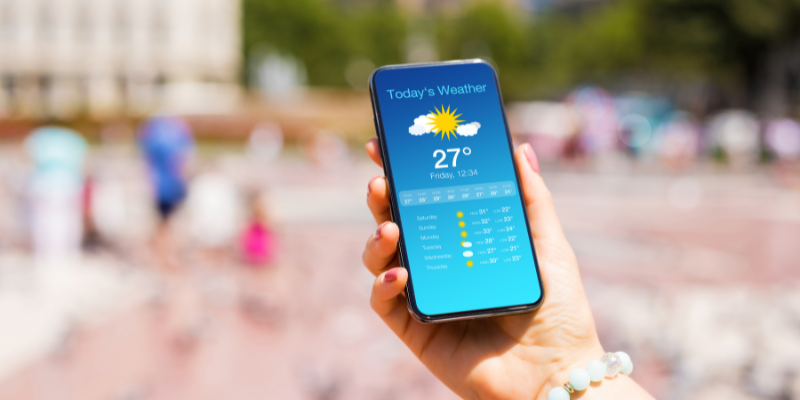
Open any weather app this July and it will tell you what is coming—but this month, the story that matters most may be the one drifting in from somewhere else. Right now, smoke from hundreds of wildfires burning across Canada and the northern U.S. is pouring south, turning skies hazy and triggering air-quality alerts in state after state—from the Upper Midwest and the Great Lakes shoreline to the Northeast and New England. And smoke is not the only thing in the air. Across the South and the Midwest, heat domes are building out of the Rockies with heat-index values pushing past 100°F, and wherever high humidity piles on top of the heat, the air turns thick and heavy. A red banner for the heat, a humidity reading that explains why your shirt is stuck to your back, a wind advisory, a smoke alert—this is exactly the kind of summer forecasters are tracking.
Those are the things you can see, feel, and check. When the air quality dips, your weather app will even flag it—the air-quality index tracks particulate matter, the fine particles in wildfire smoke and summer haze, along with a few other pollutants like ozone. But that reading only tells part of the story. It does not track the chemicals riding along with the smoke—the VOCs, formaldehyde, and other gases—and it says nothing about the mold, pollen, or dust-mite allergens building up indoors, or the pesticide drift moving in on the wind. That is what this new series, Under the Radar, is about: the real effects of extreme weather that slip past the readings because nobody is tracking them. And here is the part that matters most: just because you cannot see a haze, smell smoke, or spot particles in the air does not mean you are not being affected. Your body keeps the score—even when the forecast comes back clear.
If you have ever felt inexplicably worse on a muggy afternoon or a gusty day and chalked it up to “just being tired,” this one is for you.
The symptoms you might not be blaming on the weather
So what does “under the radar” actually feel like?
When a front rolls through and the barometric pressure drops, that shift alone can set off headaches and migraines—sometimes 6 to 12 hours before the rain even arrives—along with stuffy or aching sinuses and flare-ups of joint and arthritis pain as your tissues subtly swell. Layer humidity and the allergens it feeds on top, and you get the familiar mix: congestion, sneezing, itchy or burning eyes, a scratchy throat, coughing, and that foggy, wrung-out fatigue that makes an ordinary day feel like wading through mud.
On a smoky or hazy day the list only grows—headaches, dizziness, chest tightness, a racing heart, and tiredness that shows up even if you never smelled smoke, because the fine particles and carbon monoxide do their work quietly. And the people who feel it first and worst are usually the ones already carrying asthma, allergies, migraines, or heart and lung conditions.
None of these arrive with a name tag. You feel sluggish, congested, headachy, or achy, and it is easy to blame a bad night’s sleep or a long week. But if your rough days keep lining up with muggy, stormy, windy, or hazy weather, that is not a coincidence—it is your body reacting to what the forecast measured, and to everything it did not.
When the air gets heavy: humidity, moisture, and what grows in the dark
Heat and humidity travel together in the summer, and when that damp air settles into a house it changes the indoor environment in ways you will not spot until symptoms show up. The EPA recommends keeping indoor relative humidity below 60%—ideally between 30% and 50%. Cross that line for even a day or two and you have built a habitat. Here is what quietly moves in.
Biological growth. Moisture is the single most important ingredient for mold. Give damp drywall, carpet backing, or wood framing a stretch above 60% humidity and mold spores start colonizing, often within 24 to 48 hours. Those spores go airborne, which is where the musty smell—and the symptoms—come from. The CDC links indoor dampness and mold to stuffy noses, sore throats, coughing, wheezing, burning eyes, and skin irritation, and notes it can worsen existing asthma and even contribute to new-onset asthma. Mold can irritate the airways of people who are not even allergic to it.
Dust mites. These microscopic pests thrive in humidity between roughly 70% and 80%, and it is not the mites themselves that get you—it is their droppings, one of the most common indoor allergens on earth. Inhaled, those proteins trigger allergy and asthma flare-ups, and children allergic to dust mites are markedly more likely to develop asthma.
Chemical off-gassing. Here is one almost nobody connects to the weather: warm, humid air makes your belongings release more chemicals. Paints, new carpet, and pressed-wood furniture off-gas formaldehyde and other VOCs faster as temperature and moisture climb—one review found formaldehyde emissions from particleboard roughly doubled when humidity rose from 30% to 70%. Your furniture is, quite literally, more toxic on a hot, sticky day.
Respiratory irritation. There is a reason humid air feels “heavy.” Breathing it in can activate sensory nerves that narrow the airways, while swelling and extra mucus make each breath harder to pull—especially for anyone with asthma or COPD. A well-known study found that simply breathing hot, humid air was enough to trigger symptoms in people with mild asthma.
HVAC strain. Damp, heavy air reduces circulation, drags down the efficiency of your filters, and forces your cooling system to work overtime just to wring the moisture out—which means it is often moving air around without truly cleaning it.
When the wind delivers: smoke, pollen, and chemistry from somewhere else
If humidity is the threat that grows in place, wind is the one that ships problems from hundreds of miles away. A breeze feels like relief. It is also a conveyor belt.
Wildfire smoke. Smoke does not stay near the fire. Right now, smoke from hundreds of wildfires across Canada and the northern U.S. is doing exactly that—drifting hundreds, sometimes thousands, of miles to trigger air-quality alerts far from any flames, and studies tracking that intra-continental transport find it carries real, measurable health risk deep into regions that never see the fire. Here is what catches people off guard: you do not have to see thick haze to be breathing it. Smoke can ride high in the atmosphere or thin out enough that the sky looks nearly clear, while the fine particulate matter (PM2.5) and gases have already settled into your neighborhood—which is why a smoky day can leave you with a headache, a scratchy throat, chest tightness, or unusual fatigue before you ever notice the smell. And it is not just “campfire”: when fires reach towns and industry, aerosolized metals, plastics, and other toxics ride along, mixed in with pollen and mold spores swept up by the same hot, dry winds. You can be nowhere near a fire and still breathe its output. And the people who feel it first and worst are usually those already carrying asthma, COPD, or heart conditions, along with young children and older adults.
Pollen. Pollen goes where the wind goes, staying suspended and traveling far—and humid air keeps it (along with mold and dust) hanging in the air longer instead of settling.
Pesticides and chemicals. These drift, too. The EPA even has a name for it—pesticide drift—the airborne movement of sprays away from where they were applied. A meaningful share of what gets applied is carried off by air currents, drifting from a few hundred feet to several miles onto neighboring homes and yards. It is invisible, it is often odorless, and it is absolutely not on your weather app.
Here is the through-line: mold, VOCs, drifting chemicals, and long-haul smoke share one trait—nobody is issuing an alert for them. There is no push notification for “elevated formaldehyde in your living room” or “trace pesticide drift from three towns over.” The forecast covers what a sensor on a pole can measure. The rest lands on your lungs unannounced.
Building a place the weather can’t reach
You cannot reroute a jet stream or talk a heat dome out of forming. What you can control is the air inside the four walls where you spend most of your time. The goal of this series is not fear—it is a safe room. A place where, whatever the sky is doing, the air is clean.
That is the whole idea behind a proper air purifier, and it is where Austin Air’s medical-grade machines earn their keep. Each one pulls air in from all sides through pre-filters, a deep bed of activated carbon and zeolite, and true medical-grade HEPA rated to capture 99.97% of particles down to 0.3 microns, including mold spores, pollen, dust-mite debris, and smoke. Advanced models offer even more advanced protection. Because different weather threats call for different defenses, the lineup is built to match.
Air purifiers for mold, allergies, and asthma—the HealthMate. This clinically proven HEPA-and-carbon system is designed to pull the spores, mycotoxins, pollen, and dust-mite allergens that humid weather stirs up right out of the air.
Air purifiers for wildfire smoke and chemicals—the HealthMate Plus or the Immunity Machine. Both add unique impregnated carbon and mineral filtration built specifically to trap VOCs, formaldehyde, benzene, and smoke; the Immunity Machine layers in the broadest chemical and gas protection Austin Air makes, for the days the wind brings something worse than pollen. With up to 15 pounds of granular sorbent media—far more than most air purifiers carry—they are built to keep working even when the air is saturated with smoke, exactly the conditions a wildfire event creates.
Air purifier for genuinely restful sleep—the Bedroom Machine. It pairs comprehensive filtration with quiet operation so your bedroom becomes the cleanest-air room in the house—the place your lungs get to recover overnight.
One purifier protects a room. A whole-home bundle protects the place you actually live—the bedroom you sleep in, the living room you relax in, the spaces where the “heavy” days hit hardest. You do not have to build the whole safe place at once, but the more of your home you cover, the fewer of these under-the-radar threats have anywhere to land.
The weather report will keep telling you about the rain, the heat, and the wind. Consider this series the part it leaves out—we’ll continue the conversation on our social channels. Follow us there for more important information.
REFERENCES
¹ National Oceanic and Atmospheric Administration Climate Prediction Center and National Weather Service (2026) Seasonal and probabilistic hazards outlooks. July 2026. Available at: NOAA Climate Prediction Center Seasonal Outlooks
² Cleveland Clinic (2022) Barometric Pressure Headache: Can Weather Trigger Headaches or Migraines? 15 July. Available at: https://health.clevelandclinic.org/barometric-pressure-headache
³ Mayo Clinic Health System (2025) Understanding the complex health risks of wildfire smoke. 7 October. Available at: https://www.mayoclinichealthsystem.org/hometown-health/speaking-of-health/wildfire-smoke-complex-health-risks
⁴ U.S. Environmental Protection Agency (n.d.) Mold Course, Chapter 2: Why and Where Mold Grows. Available at: https://www.epa.gov/mold/mold-course-chapter-2
⁵ U.S. Environmental Protection Agency (n.d.) Mold Course, Chapter 2: Why and Where Mold Grows. Available at: https://www.epa.gov/mold/mold-course-chapter-2
⁶ Centers for Disease Control and Prevention (2024) About Mold. Available at: https://www.cdc.gov/mold/about/index.html
⁷ American Lung Association (n.d.) Dust Mites. Available at: https://www.lung.org/clean-air/indoor-air/indoor-air-pollutants/dust-mites
⁸ National Jewish Health (2017) Allergy Trigger of Childhood Asthma. Available at: https://www.nationaljewish.org/conditions/pediatric-asthma/overview/triggers/allergies
⁹ Zhu, Y., Guo, S. and Liang, W. (2024) ‘A literature review investigating the impact of temperature and humidity on volatile organic compound emissions from building materials’, Building and Environment, 262, 111845. Available at: https://doi.org/10.1016/j.buildenv.2024.111845
¹⁰ Asthma and Allergy Foundation of America (2023) 3 Ways Humidity Affects Asthma. 19 July. Available at: https://community.aafa.org/blog/3-ways-humidity-affects-asthma
¹¹ Nationwide Children’s Hospital (2012) Study: Why Hot, Humid Air Triggers Symptoms in Patients with Mild Asthma. 6 June. Available at: https://www.nationwidechildrens.org/newsroom/news-releases/2012/06/study-why-hot-humid-air-triggers-symptoms-in-patients-with-mild-asthma
¹² Bruce, E.D., Folorunsho, A., Jaisawal, N., Gaw, E. and Li, Y. (2025) ‘Intra-Continental Transport of Western Wildfire Smoke Heightens Health Risks Across North America’, International Journal of Environmental Research and Public Health, 22(2), 226. Available at: https://doi.org/10.3390/ijerph22020226
¹³ Wildfire & Forest Communities Alliance (n.d.) How Far Can Wildfire Smoke Travel? Available at: https://wildfireandforestcommunities.org/how-far-can-wildfire-smoke-travel/
¹⁵ U.S. Environmental Protection Agency (n.d.) Introduction to Pesticide Drift. Available at: https://www.epa.gov/reducing-pesticide-drift/introduction-pesticide-drift
¹⁶ Austin Air Systems (n.d.) HealthMate Air Purifier. Available at: https://austinair.com/shop/healthmate/
¹⁸ Austin Air Systems (n.d.) HealthMate Plus Air Purifier. Available at: https://austinair.com/shop/healthmate-plus/
¹⁹ Austin Air Systems (n.d.) Bedroom Machine Air Purifier. Available at: https://austinair.com/shop/bedroom-machine/
²⁰ Austin Air Systems (n.d.) Bedroom Machine Air Purifier. Available at: https://austinair.com/shop/bedroom-machine/
Last updated July 17, 2026