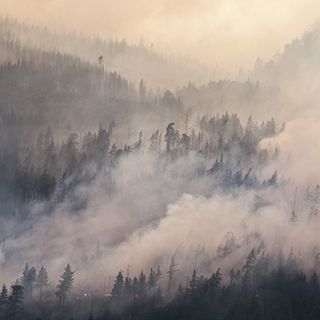
This year we have seen an unprecedented number of wildfires, burning all over the planet. Fires in Greece, Russia, Spain and Turkey have burnt millions of hectares of land, creating the highest carbon dioxide emissions in decades.
Closer to home, the Dixie Fire in California has become the second largest fire in California’s history, burning almost a million acres and destroying hundreds of structures. And while California is always the hardest hit, it was a bad year for Idaho, Oregon, Arizona and Washington too.
Smoke travels thousands of miles
And it’s not just the areas immediately surrounding the fires that are affected. Smoke from fires on the west coast reached New York this year, putting people at risk, even if they were thousands of miles away.
According to analysis of federal satellite imagery, Americans are breathing more wildfire smoke now than they did ten years ago. In San Jose in California, the number of smoke days increased by 400%, in Los Angeles and San Diego they saw a 230% increase, and even on the east coast, in Philadelphia and Washington, there was a 40% rise.
Wildfires create more emissions than Europe does in an entire year
Data compiled by Mark Parrington, a senior scientist at the European Union’s Copernicus Atmosphere Monitoring Service, reveals that up until mid-August this year, wildfires had released around 4.3 gigatons of CO2 globally, that’s more than Europe emits in an entire year.
Wildfire smoke is the most dangerous type of pollution
The very nature of wildfires, burning everything and anything in their path, results in a particularly toxic mix of chemicals and pollutants. In recent months there have been a number of studies connecting smoke from fires to a wide range of health issues.
Smoke particles affect our brain
A review article, written by scientists Adam Schuller and Luke Montrose, pulls together all the latest research, to explain how particles from wood smoke can reach the brain and therefore contribute to cognitive decline and diseases such as Alzheimer’s.
This can happen in a number of different ways:
The smallest smoke particles are inhaled into the lungs, they then pass through the lining of the lungs, enter the blood stream and travel to the brain.
The particles stay in the lungs but generate inflammatory signals that travel through the blood into the brain.
Another theory is that the particles do not need to get to the lungs at all, just being present in the nose gives them access to the brain via nerve bundles.
However it happens, it is this inflammation in the brain, that scientists believe leads to a wide range of conditions, including strokes, dementia, Parkinson’s, Alzheimer’s, cognitive dysfunction, neurodevelopmental disorders and depression.
Wildfire smoke linked to miscarriages
In another study just published, researchers found that exposure to wildfire smoke had a significant impact on the risk of miscarriage. The study took place at the California National Primate Research Institute during 2018, when the nearby Camp Fire took hold. That year, 45 of the macaques were pregnant, 37 gave birth and 8 miscarried. This relates to an 82% success rate, far lower than the 90% rate of success seen in previous years. Suggesting that exposure to smoke in the early stages of pregnancy can lead to a greater chance of miscarriage.
Preterm births on the rise in fire season
And the pregnancy risks don’t stop there. Scientists from Stanford University have discovered that exposure to smoke could also be linked to preterm birth. They looked at data between 2007 and 2012 and believe that wildfire smoke could account for as many as 7,000 early births.
According to the study, “For each day of exposure to wildfire smoke during pregnancy, the risk of preterm birth increased by 0.49%.”
Protect yourself from smoke with Austin Air
Whether you’re pregnant, planning a family or concerned about strokes and cognitive decline, if you live in an area affected by the fires, we recommend the Austin Air HealthMate Plus. Using a combination of Medical Grade Certified HEPA Material and a unique carbon blend, the Austin Air HealthMate Plus is extremely effective at removing a wide range of pollutants, including wildfire smoke.
If you’d like more info on the Healthmate Plus or any of the other air purifiers in our range, please don’t hesitate to contact one of the team today at info@austinair.com, or read more HERE.