Fires. They happen often. And everywhere.
There was the infamous train derailment and subsequent explosion in East Palestine, Ohio. And the waste recycling facility fire in Doral, FL. There was the dairy farm fire in Dimmit, Texas. The explosion at Ohio manufacturing plant… and the Richmond, Indiana plant… and the Brunswick, Georgia plant.
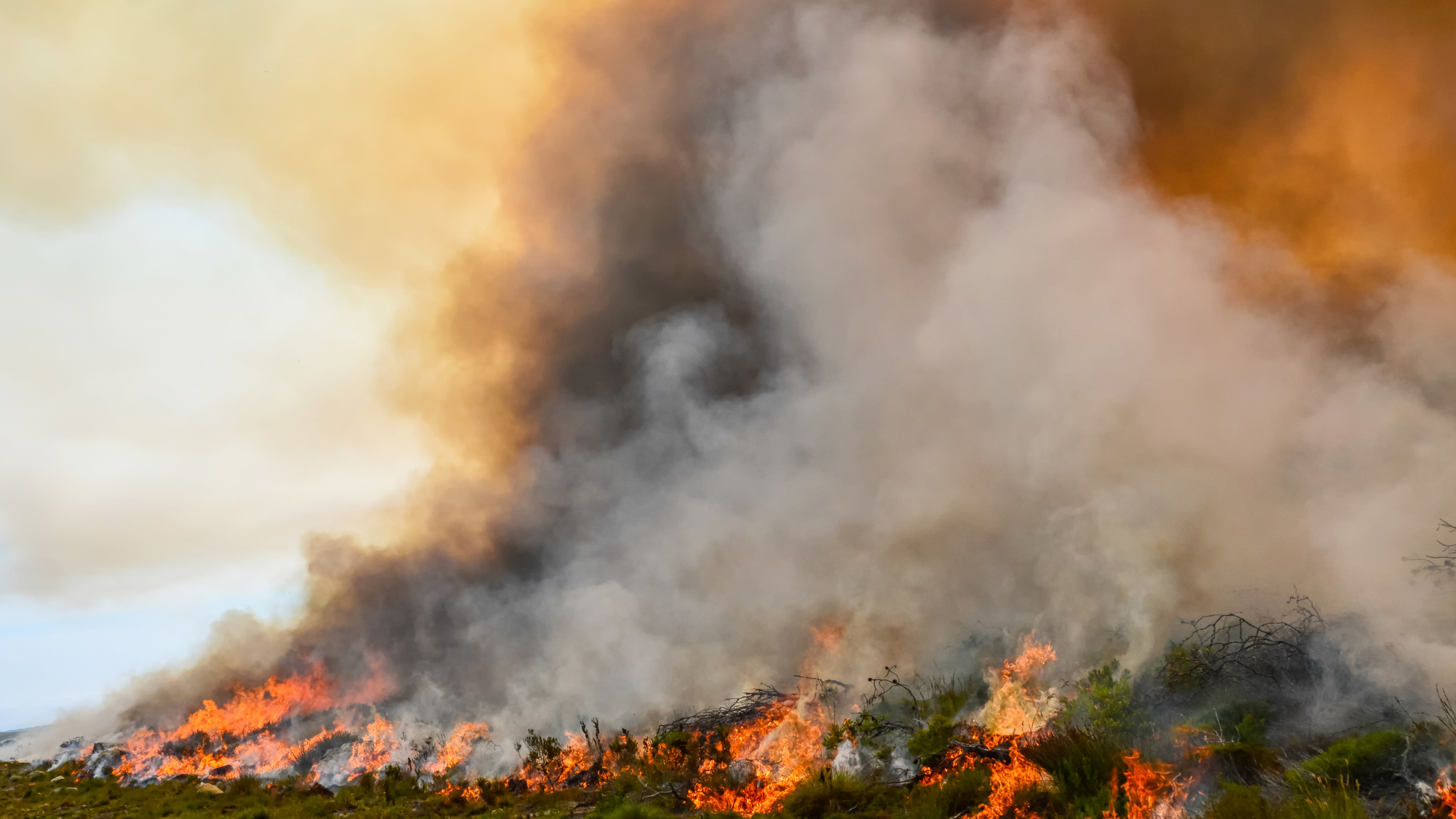
These are just a few of the many explosions to hit the landscape of the United States in recent months. And it’s not to mention the wildfires. So far in 2023, 11,246 wildfires have burned 302,755 acres. From the Rocky Mountains to New Jersey and even Pennsylvania. (1)
It seems we are quite literally experiencing the combustion of the country. And that’s a problem.
Combustion results in pollutants.
Combustion creates airborne pollutants – whether from a wildfire or factory explosion. Combustion pollutants are the gases and particles produced when burning any fuel – wood, natural gas, kerosene, charcoal, etc. Some common combustion pollutants include carbon monoxide (CO), nitrogen dioxide (NO2), fine and ultrafine particles, polycyclic aromatic hydrocarbons (PAHs), and formaldehyde. (2) All of which are harmful to human health.
The combustion of chlorinated compounds such as vinyl chloride (found on the East Palestine rail cars), creates an even more problematic byproduct known as dioxin.
According to Dr. Lyn Patrick, board advisor of the National Association of Environmental Medicine (NAEM) and cofounder of Environmental Medicine Education International (EMEI), dioxins and difurans are the most toxic synthetic chemicals produced gram per gram next to radioactive nuclear waste.
“The CDC, EPA and NIEHS all agree: There is NO safe level of dioxin,” Dr. Patrick told Austin Air. (3)
Unfortunately, testing of the contaminated East Palestine soil found every dioxin and furan analyzed for — a total of 10 varieties. (4) Among those dioxins were tetrachlorodibenzo-p-dioxin (TCDD), the most toxic dioxin. TCDD is toxic at levels of one trillionth of a gram. It is so toxic it was used in the attempted assassination of Victor Yushchenko when he was running for President of Ukraine in 2004.
According to Dr. Anne Marie Fine, Medical Director at EMEI, member and fellow of the American Academy of Environmental Medicine, and science advisor for the non-profit MadeSafe.org, the dioxins released from the East Palestine incident are some of “the most carcinogenic substances known to man.”
Pollutants know no borders.
What’s perhaps most concerning is that these dangers aren’t localized to the geographical areas where these disasters occur. Smoke and chemicals can linger in the atmosphere for weeks and travel hundreds, even thousands of miles, impacting the health of populations far and wide (5).
For example, wildfires burning on the west coast have been known to impact the air quality of eastern states such as New York and Pennsylvania. (6) Air pollution from China, India and several other Asian countries has wafted across the Pacific Ocean increasing levels of smog in the western U.S. (7)
This then begs the question: how far have the combustion pollutants from Indiana, Florida, Texas, and Georgia travelled? Where have the dioxin and difurans from East Palestine ended up? Last week a tractor-trailer carrying contaminated soil out of East Palestine overturned on a state highway in Columbiana County, OH, spilling about 20,000 pounds of soil. (8)
Sometimes, the “dust settles” in the media, and disasters fall off the headlines. But the real dust doesn’t actually stay settled in these areas. Chemicals can linger in vents, furniture, drapes, carpets, surfaces, and HVAC systems. They can be resuspended into the air any time soil is disturbed.
Sure, evacuation and ‘shelter in place’ orders may have lifted, but does that mean the air is really safe?
According to the World Health Organization (WHO), only 1% of the world breathes clean air, and 78% of people live near a superfund site (a contaminated site that exists due to hazardous waste being dumped). (9)
What can we do?
If exposed to combustion pollutants (which we all are), air purification is a MUST. But not just any air purifier will do. To capture both the particulate matter and chemicals released from combustion, the air purifier must use both Certified HEPA Material and activated carbon – especially when it comes to dioxins. (10) Thankfully, Austin Air purifiers use 60 sq. ft. of true medical Certified HEPA Material and up to 15 lbs. of activated carbon. That’s more than anyone else in the industry.
Austin Air even goes a step further when it comes to chemicals, as our HealthMate Plus air purifier has potassium iodide-impregnated carbon to remove even more chemicals, including formaldehyde, sulfur (11) and elemental mercury. (12)
The Austin Air Bedroom Machine uses a HEGA cloth that was developed by the British Armed Forces in the 1970s as protection against chemical and gas warfare. It was initially used – and still is to this day – as a protective layer in military clothing and masks to protect against chemical, biological, radioactive, and nuclear (CBRN) agents.
What’s more, Austin Air purifiers have also been tested by Battelle Laboratories, the world’s largest independent research organization. It is regularly used to assist the U.S. government in finding safe and effective methods of chemical disposal. In testing, Austin Air purifiers more than 100 other air purifiers.
For more information about staying safe in a chemical disaster, visit www.ChemicalDisasters.com
References:
- https://www.nifc.gov/fire-information/nfn
- https://ww2.arb.ca.gov/resources/documents/combustion-pollutants-indoor-air-quality#:~:text=Contact&text=Combustion%20pollutants%20are%20the%20gases,hydrocarbons%20(PAHs)%2C%20and%20formaldehyde
- https://youtu.be/m4d7NlzkwjI
- https://planetwavesfm.substack.com/p/indiana-testing-of-e-palestine-soil
- https://www.epa.gov/wildfire-smoke-course/challenges-predicting-smoke-concentrations
- https://www.npr.org/2021/07/21/1018865569/the-western-wildfires-are-affecting-people-3-000-miles-away
- https://www.usatoday.com/story/weather/2017/03/02/air-pollution-asia-wafting-into-usa-increasing-smog-west/98647354/
- https://www.washingtonpost.com/climate-environment/2023/04/12/east-palestine-truck-spill-soil/
- https://www.epa.gov/superfund/what-superfund
- https://pubmed.ncbi.nlm.nih.gov/34509483/#:~:text=Activated%20carbon%20is%
- https://www.cabotcorp.com/~/media/files/articles/activated-carbon/article-chemical-engineering-july-2017-activated-carbon-fundamentals-and-new-applications.pdf
- https://link.springer.com/article/10.1007/s11814-016-0305-1